
Nobody is sure if it was Oscar Wilde or Mark Twain who described golf as ‘a good walk spoiled.’
Whichever of those renowned wits uttered those words, Tomorrow’s Golf League (TGL) is making that description sound hollow by showing you don’t need to walk to play golf, just bring it indoors.
TGL is the latest innovation to feed an American obsession to homogenise sport, make it perfect for TV (or more likely streaming these days) and make it easy to watch from the comfort of your Lay-z Boy reclining armchair.
It is a golf championship played using a golf simulator.
Golf simulators have been around for a while. FSOM can remember being invited to try out an early version at a local club, probably back in the 1990s, although the good Lord above knows why FSOM was selected.
FSOM had retired from golf – or perhaps golf had retired from him – several years previously after a series of life-threatening incidents.
It’s hard to believe, but FSOM does have a short fuse and his frustration at his ball not describing a wonderful parabolic arc off the tee almost always led to a spluttering of oaths and a club hurled through the air in the sort of parabolic arc he could only wish his ball had described.
It earned him the reputation as the Club Chucker of Southampton Muni and anybody unwise to play with him would come equipped with a hard hat and an ability to duck quickly, while Air Defence was regularly placed on high alert to track his orbiting clubs.
As well as the Club Chucker, FSOM was known as Robin Hood for the amount time he spent in the woods, searching for balls that had been mercilessly sliced into the undergrowth.
For all that, FSOM is still the holder of the May Family mini golf challenge. This prestigious tournament took place during family holidays to Florida and the field consisted of The Good Doctor (son Joel) and HRH The Princess (daughter Erin), neither of who could match FSOM’s wily putting skills on the Congo River Rapids or Pirates Adventure courses.
So it was that FSOM was invited to trial the golf simulator. Taking up a golf bat (other than a putter) for the first time in a decade, he placed his ball on the tee, 20 feet from the screen, only for the famous FSOM slice to take the ball off at an oblique angle to completely miss the on-screen fairway and smash into a wall.
Since those early primitive, clumsy models, golf simulators have developed to the point where whole tournaments are played indoors.
Compared to those early simulators, those used in TGL’s tournaments are like a Bugatti Chiron to a Hillman Imp.
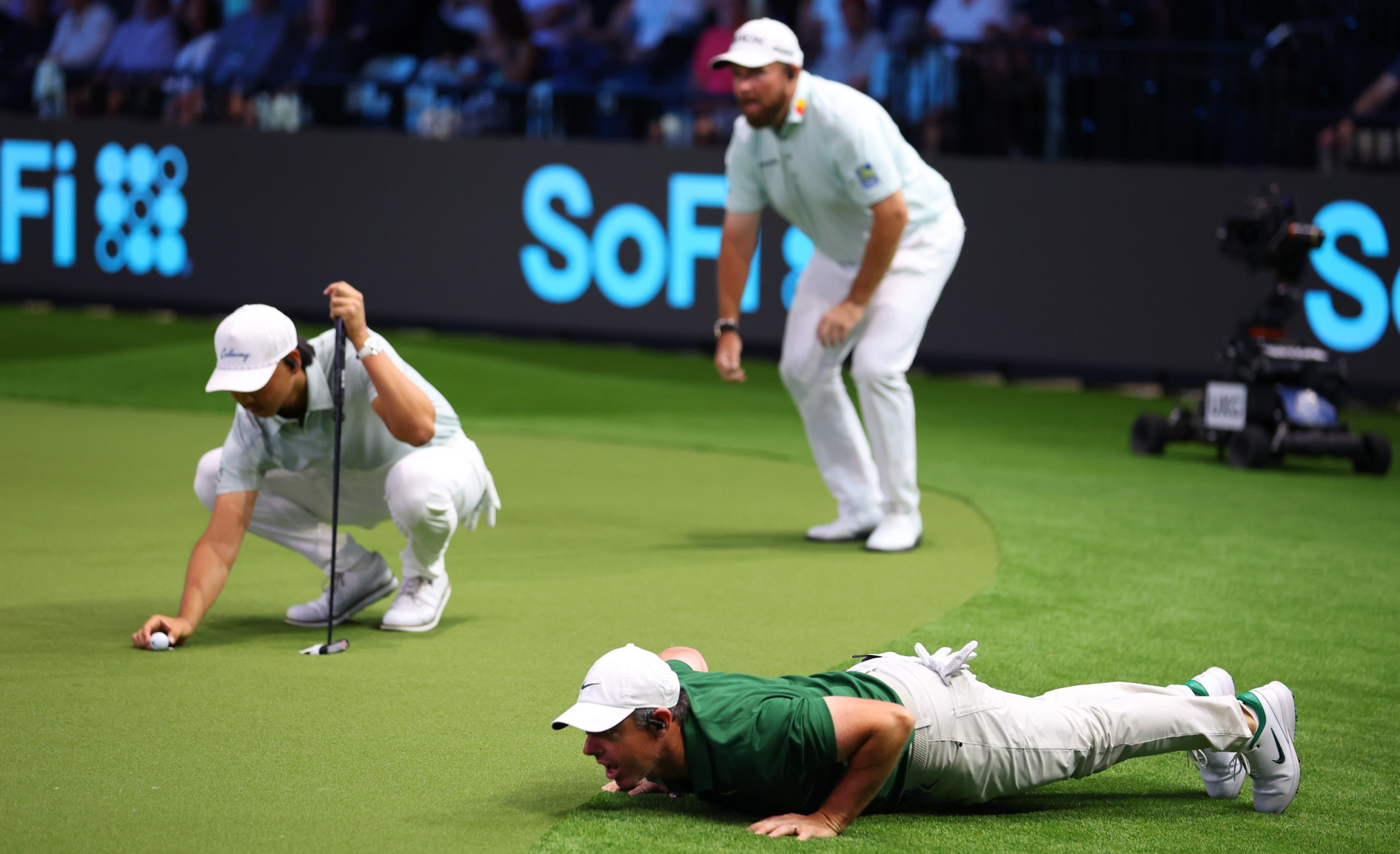
Instead of a 20ft by 10ft screen nailed on to a wall, TGL’s ‘screen’ is five stories high, as it has to be as the tournaments are played in front of live crowds of thousands and TV audiences of millions, as you would expect with players such as Tiger Woods, Rory McIlroy and Ricky Fowler taking part.
The technology involved is astounding. Players tee off on real grass dropped in like artificial cricket wickets and regard the block of flats sized wall, which can picture some of the great holes on the world’s best courses, or holes designed for the occasion to be as testing to the players as possible.
After taking advice from their virtual caddy off they go, launching the ball into not the pure open fresh air, but the air-conditioned atmosphere of an indoor arena.
The screen calculates where their ball will lie, and again, there is natural grass whether the next shot is played from fairway – short, manicured grass – or rough – thicker, longer. Being played off a natural surface, there will, of course, be divots.
Bunkers contain real sand and can be tilted to simulate a lip.
But the greens steal the show. The greens are on a large rotating platform so several can be offered, and they also are real grass. But underneath are hundreds of springs and piles which can be raised or lowered to provide the subtle undulations and variations of a real life green, so the players have to crouch down and read their putts.
The technology involved and employed means TGL is just like the real thing.
Except it’s not.
One of the virtues of golf, when you are not avoiding low-flying clubs, is that it gets you out into the fresh air.
And surely the test of a golfer’s skills is to assess the prevailing meteorological conditions, especially those on the British links courses where The Open Championship is played.
It is the joy of teeing up on the first at Turnberry where the rain is lashing horizontally and the wind is so strong the ball could blow straight back into a golfer’s face and risk a choking incident if he doesn’t close his mouth.
We’re taking courses where to stray off the fairway takes a player into rough where the grass is so long, he risks meeting a Japanese corporal who refuses to believe the Second World War is over.
If you conducted a secret straw poll among the top American golfers, they would admit to hating the Open because the conditions can make it a bit of a lottery, but certainly a test of their abilities to adjust to adverse weather, and their waterproofs.
Americans prefer low score golf, where par is just a number to be mocked, played on beautifully manicured courses where the rough is just the length of your back garden if you miss cutting it for a couple of weeks and the biggest danger is wildlife – rattlers in the desert courses of Nevada and Arizona, ‘gators in Florida.
And that’s what TGL will provide (minus the Diamondbacks and the ‘gators).
It’s artificial, it’s synthetic, manufactured, homogenised. But it’s as popular as hell.
It’s a team-based format, based loosely on US cities; Atlanta Drive, Jupiter Links (Florida), Los Angeles Golf Club, New York GC, The Bay GC (San Francisco), Motor City GC (Detroit), and Boston Common golf club, owned by Liverpool’s owners, Fenway Sports Group.
Owners and investors include Shaquille O’Neal and fellow NBA stars Stephen Curry and Kevin Durant, seven-time F1 world champion Lewis Hamilton, MLB superstar Shohei Ohtani, tennis legend Serena Williams and singer Justin Timberlake.
As expected for a TV-led and backed tournament it attracts the world’s top players, from McIlroy, Justin Rose and Shane Lowry, Fowler, Patrick Cantlay and Woods, who gets to play in the team he owns, Jupiter Links.
TGL was intended to tee off in 2024, but ironically it was delayed after the roof of the So-Fi centre venue was blown off in the sort of wind conditions the players would never encounter.
The venues were sell-outs and the television audiences huge, but importantly, the audience for the inaugural night was younger than the traditional golf demographic, hinting that it is the sort of thing that will attract a computer gaming audience.
So, having dragged golf indoors what next?
Well, simulated football and F1 racing has been in indoors a while but who knows where this can go?
Chinese robotics are so advanced they have developed robots which can box (although the fighting purpose probably has a more serious longer-term, military aim).
Marathon running is easily convertible. No need to risk burned feet on that sun scorched asphalt or be soaked with rain. Just use a treadmill and project a nice leafy background in.
Same with the Tour de France where the biggest benefit would be avoidance of that annoying Belgian guy who dresses as the devil and runs with the peloton until his ticker gives out.
Yes, bringing the outdoors and its sports indoors is the way forward.
As a keen angler, FSOM wonders if he could flood the bathroom.
Share this:
- Share on Bluesky (Opens in new window) Bluesky
- Email a link to a friend (Opens in new window) Email
- Share on Facebook (Opens in new window) Facebook
- Share on Reddit (Opens in new window) Reddit
- Share on Threads (Opens in new window) Threads
- Share on WhatsApp (Opens in new window) WhatsApp
- Share on X (Opens in new window) X
Related

Must See
-


Features
/ 2 months agoEXCLUSIVE INTERVIEW: Marc White on Dorking Wanderers’ rise from park football to global screens and their future aspirations
Dorking Wanderers, a National League South side with international recognition, are taking the social...
By Jameel Mulla -


Boxing
/ 2 months agoTop five sporting events of 2025: From Rory McIlroy finally winning the Masters, to England Women’s Rugby World Cup triumph and more
It’s been another remarkable 12 months of sport that has provided plenty of entertainment...
By Ben Potts -


50 Shades of May
/ 4 months agoFSOM: Grassroots football is dying on its a*** and we should be very concerned – here’s why I give the recreational game 10-15 years max
Sometimes when you poke a dead horse with a pointy stick a miracle occurs...
By John May


