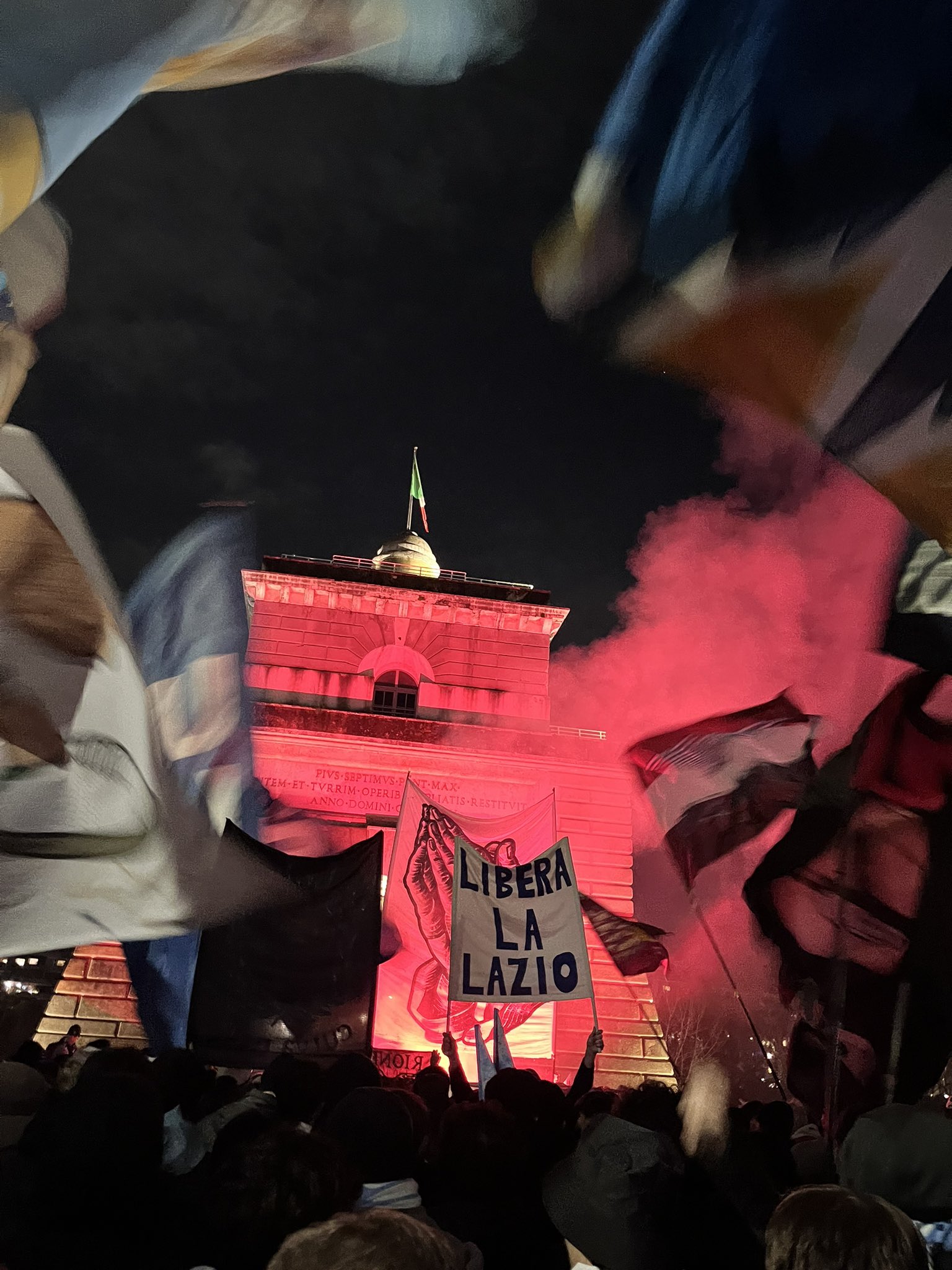
Italian football lives on emotion.
It breathes through banners, choreographies, silence, and revolt.
Right now, two of Serie A’s historic institutions remain locked in long-running protest movements:
- S.S. Lazio vs Claudio Lotito
- Torino FC vs Urbano Cairo
Both are “owner out” campaigns.
But they are not the same story.
Matchday as Protest: Recent Flashpoints
This season has already seen tangible escalations.
For Lazio, boycotts have hit multiple fixtures:
- Lecce at home
- Genoa at home
- Atalanta at home
The boycott against Genoa was particularly striking. Large sections of the Curva Nord remained empty, transforming what should have been a routine home match into a visual statement that travelled far beyond Rome. Images of the vacant end circulated globally on social media, sparking debate not just in Italy but across European football circles. The absence became louder than any chant.
It wasn’t about the opponent.
It wasn’t about the result.
It was about the ownership.
Meanwhile, in Turin last week, Torino supporters staged their own boycott during the home fixture against Bologna. Sections of the Curva Maratona made their dissatisfaction visible, reinforcing months of frustration directed at Cairo’s perceived lack of ambition. The tone, however, felt more restrained — less explosive, more weary.
Both clubs used the stadium as a stage.
Only one felt like a rupture.
Lazio: Protest as a Question of Dignity
The psychology behind Lazio’s movement is built on frustration at limitation.
Lazio are not a club in financial ruin. They are not drifting towards relegation. European football has been achieved repeatedly in recent years.
The anger stems from:
- A belief the club has an artificial ceiling
- Frustration at cautious transfer windows
- A sense of stagnation despite competitive potential
- A perception that ownership controls ambition
For many supporters, Lotito represents a gatekeeper — not a saviour.
This is not a protest born of fear.
It is a protest born of pride.
When the Curva empties, it is an act of defiance.
When social media circulates those empty stands, it becomes symbolic warfare.
“We are bigger than this.”
That is the underlying message.
Torino: Protest as Mourning
Torino’s psychology is quieter.
The weight of history shapes everything. Grande Torino remains part of daily identity, not just memory.
Under Cairo, Torino have:
- Achieved stability
- Avoided financial chaos
- Maintained Serie A status
But they have also:
- Rarely threatened European qualification
- Sold talent without transformative reinvestment
- Settled into mid-table predictability
The protest against Bologna reflected that mood — visible, organised, but lacking the volatility of Lazio’s movement.
Torino’s anger feels reflective rather than explosive.
“We are being preserved, not revived.”
It is a protest against stagnation rather than control.
Do Italian Boycotts Actually Work?
This is the uncomfortable question.
In Serie A:
- Matchday revenue represents a relatively small percentage of total income
- Broadcast rights dominate financial structure
- Most owners operate with cost containment models
An empty Curva creates headlines.
It damages optics.
It fuels narrative.
But financially, the impact is limited.
Even Lazio’s globally circulated boycott against Genoa, despite its viral reach, did not threaten ownership stability. It damaged image — not balance sheets.
For Torino, the Bologna boycott was symbolically powerful but economically marginal.
Without:
- Regulatory pressure
- Structural reform
- Or an active buyer
Boycotts in Italy rarely remove owners.
They create pressure.
They do not create exit routes.
The Bigger Question
Italian football remains one of the last arenas where emotion still shapes the narrative more than spreadsheets.
The Curva can empty.
The banners can multiply.
Social media can amplify the message worldwide.
But ownership structures remain largely untouched.
Which leaves a question that goes beyond Rome or Turin:
If your club had these owners —
if you felt ambition was capped,
if you believed stagnation had become permanent,
if you thought your club’s identity was being compromised —
Would you boycott your team’s matches?
Or is supporting through frustration part of the unwritten contract between fan and club?
Because in Rome and Turin right now, that debate is not theoretical.
It plays out every weekend.