
Sport has long been hailed as a unifying force — a place where politics, religion, and social divisions supposedly melt away in the shared joy of competition.
Yet, the reality is far more complex. From the terraces of English football grounds to Olympic podiums and World Cup finals, politics and sport have always been intertwined.
While many English fans insist that politics should be kept out of football, history — and current events — prove that this is easier said than done.
The Illusion of “Keeping Politics Out of Football”
In England, chants of “keep politics out of football” often echo when players take the knee, display solidarity with causes, or speak out about social issues.
However, the sport itself is deeply political. National anthems are played before international matches, government ministers meet with football associations, and politicians are quick to associate themselves with successful teams or tournaments.
Prime Ministers such as Boris Johnson and Rishi Sunak have used footballing moments to connect with the public, often commenting on matches or hosting victorious teams at Downing Street.
More recently, Labour leader Sir Keir Starmer entered the debate by backing Israeli fans’ right to attend matches in Birmingham following safety concerns over potential protests — a move that underlined how political leaders continue to engage directly with football-related issues to demonstrate principle, leadership, or solidarity.
In truth, football is part of the nation’s cultural identity — and politicians know that aligning themselves with the sport helps them appear relatable and patriotic.
Mussolini, Castro, and Political Pressure on Athletes
The relationship between politics and sport was perhaps most evident in the early 20th century. Benito Mussolini used football as a tool of propaganda during his Fascist regime in Italy.
Ahead of the 1938 World Cup, he reportedly met the national team at Rome’s Termini Station, issuing a chilling ultimatum: “Win — or don’t come back.” Italy went on to win the tournament, with many believing the players were motivated by fear as much as pride.
In Cuba, Fidel Castro took a similar interest in the symbolic power of sport. During the Cold War, he saw sporting success as a way to showcase the strength of his socialist system.
Cuban athletes were often paraded as national heroes — or criticised for “betraying” the nation if they failed. After one Olympic Games, Castro famously told returning athletes they could come home only if they’d fought with pride, reflecting how sport became a matter of political loyalty as much as personal achievement.
Political Gestures on the Global Stage
The 1968 Olympics in Mexico City produced one of the most iconic political moments in sports history.
American sprinters Tommie Smith and John Carlos raised their black-gloved fists during the medal ceremony to protest racial inequality in the United States.
Their silent salute — inspired by the growing civil rights and Black Power movements — remains one of the most powerful images of protest ever captured in sport.
Decades later, athletes continued this tradition of activism. When American football player Colin Kaepernick began kneeling during the U.S. national anthem in 2016 to protest police brutality, he reignited global debates about race, patriotism, and free speech.
His gesture spread across sports and continents, influencing footballers in England to take the knee before matches as a sign of solidarity — a move that divided fans and politicians alike.
Taking the Knee Today: Symbolism and Change
In the Premier League, players still take the knee — but far less frequently than during the height of the Black Lives Matter movement.
Since the 2024–25 season, the gesture has been reserved for key moments such as the opening and final rounds of the season, and during the league’s No Room for Racism matchdays.
This change was agreed collectively by club captains and players to ensure the act retained its impact and meaning.
While some argue the reduced frequency makes the message stronger by highlighting it at significant moments, others feel it signals a loss of momentum in football’s anti-racism campaign.
The evolution of the gesture reflects how sporting protests adapt to political climates — and how debates about race, identity, and activism continue to shape modern football.
Football’s Political Divide: Di Canio and Lucarelli
In Italy, few players have symbolised the political divide in football more than Paolo Di Canio and Cristiano Lucarelli.
Di Canio, known for his right-wing beliefs, caused controversy for giving a fascist-style salute to Lazio fans, claiming it was a gesture of pride rather than politics. Lucarelli, on the other hand, was a self-declared communist who once celebrated a goal by revealing a shirt with Che Guevara’s image.
While Di Canio’s salute sparked outrage and fines, Lucarelli’s left-wing views made him a cult hero among Livorno’s working-class fans. Both men demonstrate how politics can shape a player’s identity — and how football grounds often become stages for broader ideological battles.
Ahead of a Lazio vs Livorno clash in the mid-2000s, the two players even appeared together on an Italian political television programme to discuss their opposing ideologies.
The debate, which aired days before the match, captured the nation’s attention — pitting Di Canio’s nationalist, right-wing convictions against Lucarelli’s socialist beliefs. Despite their deep political differences, both men spoke respectfully, emphasising mutual passion for football and freedom of expression.
Their televised exchange highlighted how Italy’s political and sporting cultures often intersect — and how football can serve as a stage for broader discussions about identity, ideology, and society.
Politics in Italian and Spanish Football
Italian football has always reflected the country’s political divisions. Clubs like Lazio and Livorno are famous for their contrasting ideological fan bases — with sections of Lazio’s ultras historically linked to far-right symbolism, while Livorno’s supporters proudly display communist flags and chants.
Even in recent years, politics continues to echo through stadiums, from banners referencing Fascism or anti-fascism to protests against ownership and government interference.
In Spain, the connection between politics and football runs just as deep. During the Franco dictatorship, Real Madrid became associated with the Spanish state and national unity, while Barcelona stood as a symbol of Catalan identity and resistance.
The club’s motto, “Més que un club” (“More than a club”), was born from this era — a statement of cultural defiance as much as sporting pride. Even today, matches between Real Madrid and Barcelona are often seen as reflections of broader regional tensions, with chants, flags, and political statements forming part of the spectacle.
Beyond the Clásico, Basque clubs such as Athletic Bilbao have long represented nationalist sentiment through their unique identity, fielding only Basque players for much of their history. In both Italy and Spain, football isn’t just a game — it’s a mirror of identity, ideology, and historical struggle.
South Africa and the Sporting Boycott
One of the most powerful examples of politics shaping sport came during apartheid-era South Africa. From the 1960s through the early 1990s, the country was banned from most major international competitions, including the Olympics and FIFA tournaments, due to its institutionalised racial segregation. The boycott — supported by the United Nations and countless activists — made sport a key battleground in the fight against apartheid.
The exclusion isolated South Africa on the world stage and deprived it of one of its strongest sources of national pride.
Meanwhile, many athletes around the world refused to compete against South African teams, and protest movements like “Stop the Seventy Tour” in the UK brought moral and political pressure on governments and sporting bodies alike.
When Nelson Mandela was released and apartheid began to crumble, South Africa’s re-entry into international sport — highlighted by the 1995 Rugby World Cup — became a global symbol of reconciliation and unity.
Few moments have shown more clearly how sport can both reflect and help reshape a nation’s political identity.
Sportswashing and Saudi Arabia’s Global Strategy
In recent years, Saudi Arabia has emerged as one of the most striking examples of how politics, money, and sport intersect.
The kingdom has invested billions into global sports — buying Newcastle United, hosting major boxing bouts, launching the LIV Golf tour, and attracting top footballers to the Saudi Pro League.
Critics accuse the Saudi government of sportswashing — using sport to distract from its human rights record, including the murder of journalist Jamal Khashoggi and the suppression of dissent.
For Saudi Arabia, sport serves both as a soft-power tool to improve its international image and as a means to diversify its economy under the Vision 2030 plan.
While some argue this investment brings welcome development and opportunity, others see it as a calculated attempt to rebrand an authoritarian state through glamour, wealth, and global fandom.
Israel, Palestine, and the Global Sporting Response
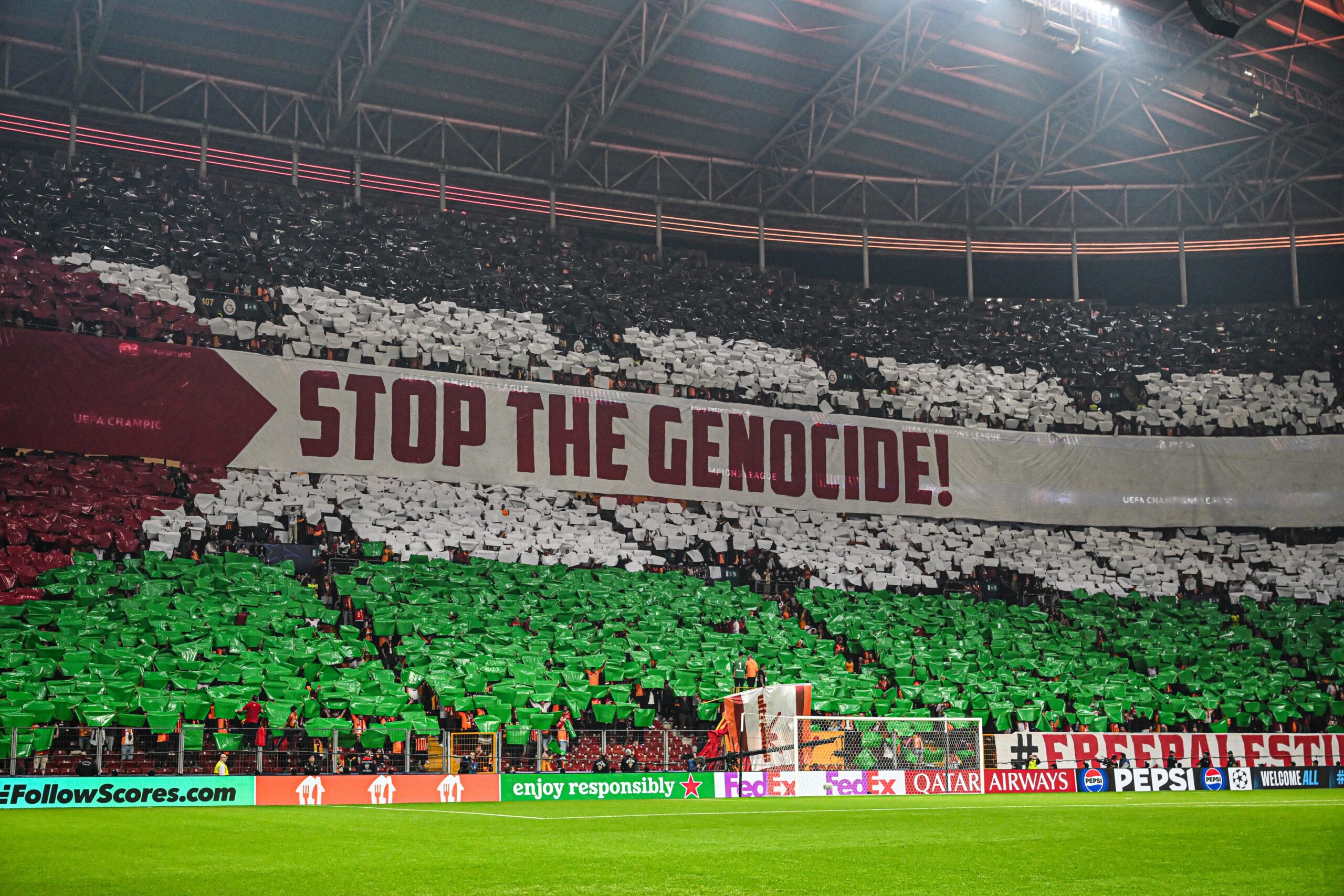
The ongoing conflict between Israel and Palestine has had a growing impact on international sport, with fans, athletes, and clubs around the world increasingly expressing solidarity with Palestine.
In stadiums from Istanbul to Glasgow, supporters have unfurled Palestinian flags and displayed banners calling for peace and justice, while some athletes have used their platforms to highlight the humanitarian crisis in Gaza.
Conversely, Israeli teams and fans have faced heightened security measures and travel restrictions, with several matches played behind closed doors or without away supporters due to safety concerns.
The situation has reignited debate about whether sport can truly remain neutral in times of conflict, as global football and other sporting bodies struggle to balance political sensitivities with freedom of expression.
Russia and the Cost of Isolation
Similarly, Russia’s invasion of Ukraine in 2022 prompted one of the most significant political interventions in modern sporting history.
Russian teams and athletes were banned from major international competitions, including FIFA and UEFA tournaments, the Olympics, and World Athletics events.
These sweeping sanctions effectively isolated Russia from global sport, marking a clear stance by international federations against state aggression.
While critics argued that individual athletes were unfairly punished for government actions, supporters saw the ban as a necessary response — a powerful statement that, in today’s world, sport cannot exist in a vacuum, detached from political and moral accountability.
Other Examples: From Boycotts to Bans
Throughout history, politics has shaped who competes and who doesn’t. The Olympic boycotts of 1980 (Moscow) and 1984 (Los Angeles) saw entire nations withdraw in protest of geopolitical tensions between the Soviet Union and the United States.
More recently, Russia has been banned from major sporting competitions following its invasion of Ukraine, while Israeli participation in sport has become increasingly controversial amid ongoing conflict in Gaza.
Even seemingly apolitical events such as World Cup hosting decisions carry deep political significance — from Qatar’s human rights criticisms in 2022 to debates about Saudi Arabia’s growing influence in global sport. Money, power, and image are all political tools in the modern sporting world.
Conclusion: The Inseparable Bond
To claim that politics can be separated from sport is to ignore reality. Sport reflects the societies it emerges from — their divisions, hopes, and struggles.
Whether it’s Mussolini using football to promote Fascism, Kaepernick kneeling for justice, Barcelona standing for Catalonia, Saudi Arabia reshaping global sport through wealth, or South Africa using sport to heal a nation, politics and sport are inseparable.
The ongoing conflict between Israel and Palestine has further highlighted how sport becomes a stage for global expression, with fans and athletes showing solidarity with Palestine, and Israeli teams facing security concerns and travel restrictions.
Similarly, Russia’s ban from international competition following its invasion of Ukraine underscored how sport can be used to take moral and political stances on the world stage.
While we might wish for a pure, apolitical game, the truth is that sport has always been — and will always be — political.
From the terraces of England to the Olympic podiums of the world, every match, gesture, and anthem tells a story not just of competition, but of the times we live in — a reminder that the arena of sport is, and always has been, a reflection of the wider world.
Share this:
- Share on Bluesky (Opens in new window) Bluesky
- Email a link to a friend (Opens in new window) Email
- Share on Facebook (Opens in new window) Facebook
- Share on Reddit (Opens in new window) Reddit
- Share on Threads (Opens in new window) Threads
- Share on WhatsApp (Opens in new window) WhatsApp
- Share on X (Opens in new window) X
Related

Must See
-


Features
/ 2 months agoEXCLUSIVE INTERVIEW: Marc White on Dorking Wanderers’ rise from park football to global screens and their future aspirations
Dorking Wanderers, a National League South side with international recognition, are taking the social...
By Jameel Mulla -


Boxing
/ 2 months agoTop five sporting events of 2025: From Rory McIlroy finally winning the Masters, to England Women’s Rugby World Cup triumph and more
It’s been another remarkable 12 months of sport that has provided plenty of entertainment...
By Ben Potts -


50 Shades of May
/ 4 months agoFSOM: Grassroots football is dying on its a*** and we should be very concerned – here’s why I give the recreational game 10-15 years max
Sometimes when you poke a dead horse with a pointy stick a miracle occurs...
By John May


