
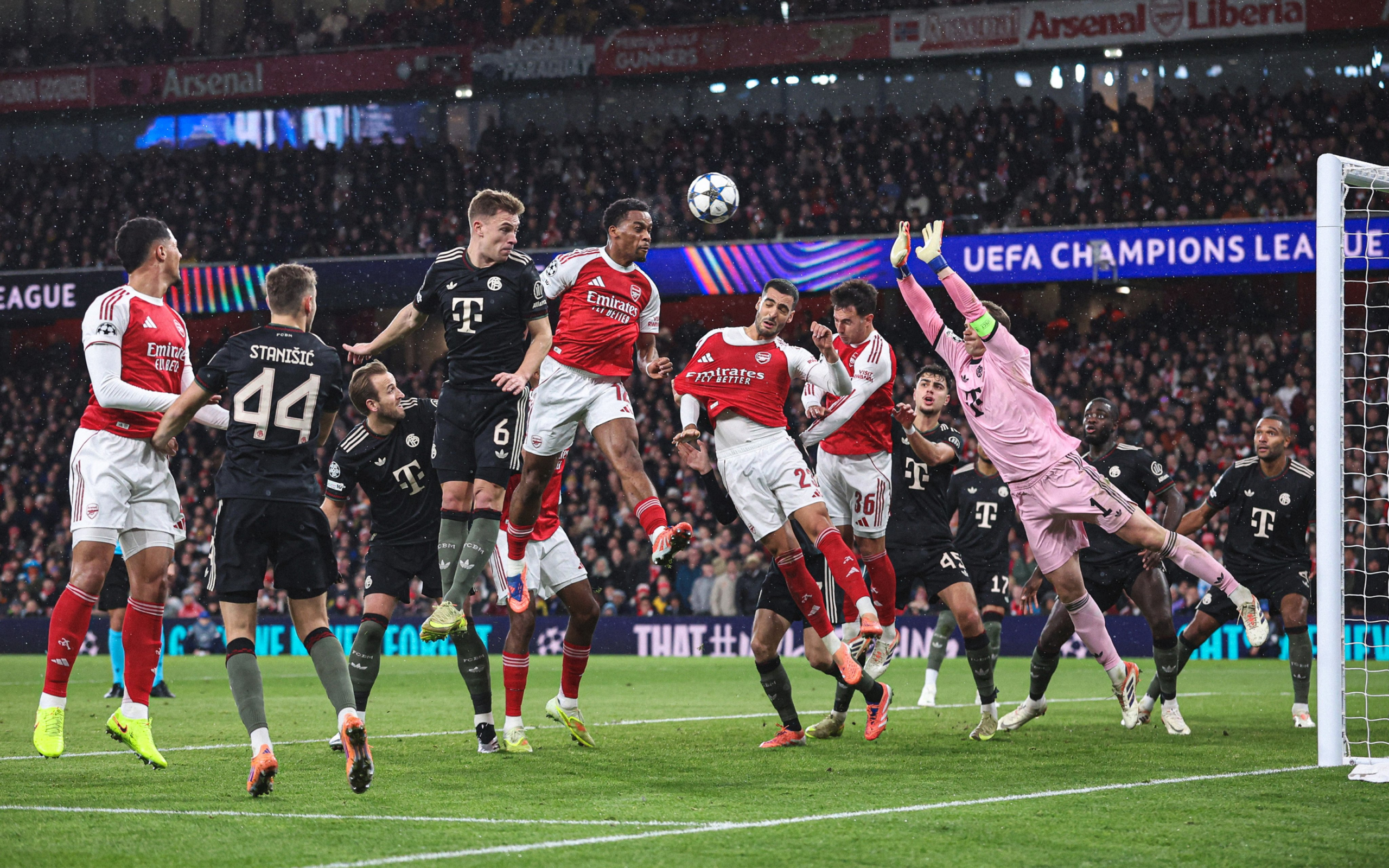
There’s an old sporting joke that says: ‘I went along to a fight and an ice hockey match broke out.’
It’s about to be updated to: ‘I popped along to a WWE night and found myself in the middle of a football match.’
Penalty-box shenanigans have become ludicrous to the point where you might expect Rowdy Roddy Piper, The Rock, or The Undertaker pitch up in the goalmouth to start body-slamming opponents around.
And they would probably get away with it.
Goalkeepers were once said to be a species more protected than the Balinese Tiger or the Yangtze finless porpoise, although go back a little further – to the 1950s – and they were fair game for those on-field nightclub bouncers known as centre-forwards.
The laws of the game said goalkeepers could be barged, shoulder-to-shoulder, in the six-yard box if they were in possession of the ball and forwards like Nat ‘the Lion of Vienna’ Lofthouse made their reputation and put the fear of god into keepers who could expect a collision with his burly shoulders in an attempt to knock him over the goalline.
FSOM once tracked down and interviewed former Manchester United keeper Ray Wood. Having survived the Munich air crash that killed many of his team-mates, Wood was reluctant to speak to the media, but he admitted to FSOM that the thing that scared him most was Aston Villa forward Peter McParland.
The 1957 FA Cup final between United and Villa was just six minutes old when Wood caught a cross and, as he planted both feet on terra firma, found McParland coming at him like the 8.15am train to Manchester Picadilly. McParland’s challenge was legal under the laws of the game, but a little overzealous to say the least as he clattered into Wood, breaking his jaw.
The laws evolved and keepers were given free rein to rule their goal areas untouched but the crowd scenes in six-yard boxes had their roots in the late 60s-early 70s when a Leeds United team, schooled in that era’s version of the dark arts, ordered England centre-half Jack Charlton, to STAND in front of the keeper at corners.
This brought howls of outrage at ‘Dirty Leeds’ although it is mild compared to today’s Tokyo Rush Hour as Charlton never touched the keeper, but merely stood in front of him and rose first and highest to nod in the pin-point corners from Eddie Gray or Johnny Giles.
Of course, it wasn’t long before other teams copied the tactic and it became the norm for keepers to have their view blocked by some big galoot.
That began the penalty box equivalent of a Great War Dreadnought arms race.
To counteract a big unit plonking himself in front of the keeper, teams would inject a defender in between to give the keeper a bit of room to manoeuvre to reach the incoming corner.
When Big Jack first planted himself in front of a keeper like a giant beanstalk, referees took pains to tell him, and those who followed him, they could do so as long as they did not move until the ball had been kicked. But this sort of fell by the wayside and astute coaches realised that by moving a few steps to the side, the keeper’s path to the ball could actually be blocked off, again apparently quite legally.
It began to get as crowded as a Friday post-work pub in six-yard boxes as defending teams employed counter blockers to block the blockers to the current point where goalmouths resemble chucking out time out time.
The sight of up to 16 players grappling in the goal is one of the most unedifying in football and it is beginning to dominate the agenda and referees appear unwilling or unable to do anything about.
Until the ball is actually in play, players can pull, tug, hold, shove and generally assault opponents. And this often continues once ethe ball is in flight.
This has come about as set pieces are becoming more important with as many as 27 per cent of goals coming from them in the Premier League but the bar for fouls committed by defenders – many of whom possibly possess judo black belts – as they apply jiu-jitsu holds on opponents is low with only seven penalties awarded this season, four of those after VAR intervention.
Yet TV replays show that most offences go unpunished and success at defending or scoring from a set piece is becoming more an issue of two falls, two submissions or a knockout.
Arsenal are the masters of the set play, having reaped 16 goals from corners, three times more than any other team. It’s not necessarily attractive but it is effective and Arsenal boss Mikel Arteta will defend the tactics to the hilt, and why wouldn’t he?
In the cut-throat world of professional football, any edge or advantage is vital, and ‘marginal gains’ are not merely a concept cooked up by cycling guru Dave Brailsford.
The object of the exercise is to be effective in both penalty areas, especially in the opposition’s where you can do damage and it can bring goals.
Ugly or not, the use and method of set pieces is an innovation, even if it is as innovative as a caveman’s flint axe, and lots of football innovations have been seemingly coarse and bumptious.
Back in the 1980s and 90s, the voice of Charles Hughes began to be heard.
Hughes was a mild-mannered, bespectacled chap who resembled a bank clerk, but he rose almost unnoticed to become the FA’s director of coaching. He wrote the FA’s coaching manual and his coaching ethos was based on data which showed the majority of goals resulted from moves which involved five passes or fewer, preferably a maximum of three.
To him, keeping hold of the ball was like holding the wrong end of the stick which had been dipped in dog poo and he once said: ‘The strategy of direct play is far preferable to possession football, the facts are irrefutable, the evidence overwhelming.’
This mantra was taken up with enthusiasm by the English game where it was seen that a robust, physical style of play where the ball propelled forward quickly to either a big lump up front, or into key areas, could see clubs with fewer resources compete with those with more talented and skilful players.
One of the keenest devotees of this was John Beck at Cambridge United who were wallowing in the lower reaches of the Fourth Division (now League Two) when he took over.
With a tall young striker named Dion Dublin as his focal point, Beck swallowed Hughes’ coaching manual and converted Cambridge into the ultimate long ball team.
Players were indoctrinated to not pass the ball, but wherever they were on the pitch, to shell it either up to Dublin as the target, or into pre-determined zones. Midfield was non-existent in Beck’s view, an area to be avoided as much as No Man’s Land on the Somme. To prove that, he made sure the pre-match warm-ups were held in the centre-circle and on the halfway line cutting the pitch up to make smooth passing nigh on impossible for the opposition midfielders – his payers didn’t use that area anyway!
On the terrace walls behind the goals, two-foot high letters screamed ‘QUALITY’ so that wherever a Cambridge player was on the pitch he could look up and see his target. Beck also ordered the groundsman to keep the grass long in the corners so the ball held up.
Beck’s Cambridge won back-to-back promotions and were 90 minutes away from the Premier League, but his methods – derived from Charles Hughes’ coaching manual – was derided by many.
But others took it up, and Graham Taylor’s success with Watford using similar tactics, with a young winger called John Barnes supplying the ammunition for Ross Jenkins, and then at Aston Villa, caught the eye of the FA hierarchy and he was appointed England manager.
But the direct football which served him well at club level, did not work against the sophisticated football of European nations and as tricky Johnny Foreigner passed England into a mesmeric state, England’s failure to qualify for the 1994 World Cup saw Taylor handed his P45.
So, what has this got to do with ruckuses at corners?
For the past years, English football – first the Premier League – has been in the thrall of Pep Guardiola. Arguably the most successful coach of his generation, his game and success has been based on possession-based football.
His tiki-taka football at Barcelona made them a force in Europe and it readily transferred to Manchester City who adopted a similar style and in the monkey-see, monkey-do world of football it has been adopted by teams from the Premier League, right to the foot of the football pyramid.
Go to a recreation ground on a Sunday morning and instead of beer-bellied bloaters aiming to kick the casing off the ball, you’ll see teams trying to make the pitch as big as possible. Meanwhile defenders who would once have kicked lumps out of the opposing centre-forward attempt a transformation into a Sunday morning Beckenbauer and start stroking the passes around with the artistry of Monet, although he might be handicapped by a playing surface as smooth as a freshly-ploughed potato field.
Goalkeepers who once would have shrieked in horror to find the ball at their feet, are now sweeper-keepers, comfortable on the ball and key elements in instigating passing moves which go through central defenders – who formerly would have leathered the ball as far up the pitch as they could – stroke the ball to midfielders who ping the ball to wide men, who knocked it to a winger who confronted by a defender, passes it back, to a defender who knocks it inside to a central defender who passes it back to the keeper who finds the other central defender who plays it forward to a midfielder and….well, you get the picture.
It’s possession football for possession’s sake.
We rarely see these days, a buccaneering winger dart on the outside of his full-back to deliver a cross to a centre-forward, leaping like a tin of salmon at the far post to nod home, or a ball lumped forward to a big target man to hold it up and bring others in to play, although City do have Erling Haaland who is a pretty good outlet for a long ball.
It sounds almost hearsay to say it, but football is becoming a tad boring, if not in its outcomes and results, but perhaps in its method and style.
Yes. possession football means the teams with the most technically gifted players will always have the skills and awareness to eventually wear down opponents in a form of Chinese water torture that is often like watching a coat of freshly applied satin gloss, dry out in the sun.
So perhaps it’s no wonder that teams see set pieces as a means of exploiting those marginal gains and to make sure they get the upper hand at corners, get set for a summer transfer window of specialist signings.
They’re from Mexican outfit Lucho Libre and while they might not be much good at heading the ball into the net, they’ll body slam a few opponents and clear a path to goal.
Share this:
- Share on Bluesky (Opens in new window) Bluesky
- Email a link to a friend (Opens in new window) Email
- Share on Facebook (Opens in new window) Facebook
- Share on Reddit (Opens in new window) Reddit
- Share on Threads (Opens in new window) Threads
- Share on WhatsApp (Opens in new window) WhatsApp
- Share on X (Opens in new window) X
Related

Must See
-


Features
/ 2 months agoEXCLUSIVE INTERVIEW: Marc White on Dorking Wanderers’ rise from park football to global screens and their future aspirations
Dorking Wanderers, a National League South side with international recognition, are taking the social...
By Jameel Mulla -


Boxing
/ 2 months agoTop five sporting events of 2025: From Rory McIlroy finally winning the Masters, to England Women’s Rugby World Cup triumph and more
It’s been another remarkable 12 months of sport that has provided plenty of entertainment...
By Ben Potts -


50 Shades of May
/ 4 months agoFSOM: Grassroots football is dying on its a*** and we should be very concerned – here’s why I give the recreational game 10-15 years max
Sometimes when you poke a dead horse with a pointy stick a miracle occurs...
By John May


