
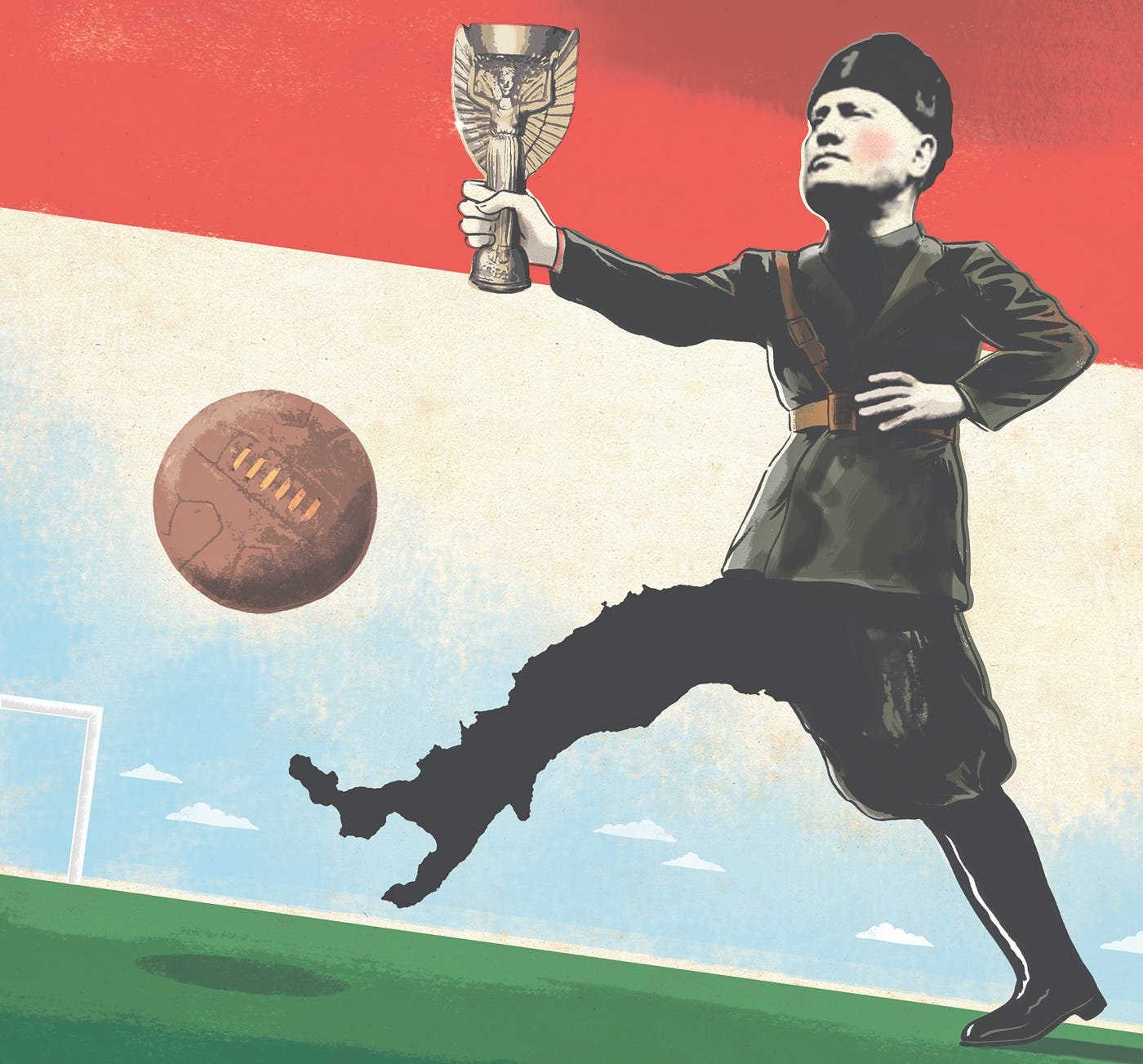
Benito Mussolini’s regime had a profound — and very deliberate — influence on Italian football in the 1920s and 1930s, both in terms of how the sport was organised and how it was used as a political tool.
The Fascist government saw football as an ideal means of promoting national unity, physical fitness, and Italy’s image abroad, and it was quick to bring the sport under its control.
When Mussolini came to power in 1922, Italian football was still fractured and regionally based, with the top division (the Prima Divisione) split into unwieldy northern and southern leagues.
The Fascist state valued efficiency, spectacle, and the ability to stage major events for propaganda purposes — and the chaotic, bloated league system didn’t fit that vision.
Throughout the 1920s, the regime pushed for centralisation and standardisation, a process accelerated by the appointment of loyal Fascist administrators to the FIGC (Italian Football Federation).
Mussolini’s government was closely involved in the reforms that culminated in 1929 with the creation of Serie A as a single, nationwide, round-robin league of 18 clubs. The change served several political purposes:
- National integration: Having northern and southern clubs in the same competition projected the image of a united, modern Italy.
- Showcase of Italian strength: The new format created a clearer, more competitive championship, producing champions who could be marketed as the pride of the nation.
- Propaganda opportunities: Big matches could be staged in modernised stadiums — many built or refurbished under Fascist urban programmes — and attended by Mussolini himself for photo opportunities.
The regime also invested in football infrastructure, funding the construction of monumental stadia such as the Stadio Littoriale in Bologna and Stadio Mussolini in Turin (now Stadio Olimpico Grande Torino). These were not just sporting venues but symbols of Fascist modernity and power.
Mussolini’s direct involvement was most visible during Italy’s successful hosting of the 1934 World Cup, when the regime used the tournament as a massive propaganda exercise. Allegations of political interference in refereeing decisions during Italy’s matches — whether true or exaggerated — became part of the sport’s folklore, further entwining Mussolini’s name with Italian football’s golden era.
In short, Mussolini didn’t invent Serie A, but without the Fascist state’s political will for centralisation, infrastructure investment, and propaganda staging, the transition to a single national league in 1929 would likely have been slower and messier. The result was a more professionalised, nationally focused football system — one that served both the sport and the state’s political ambitions.
Here’s the step-by-step path from the 1921–22 FIGC/CCI split to the launch of Serie A in 1929, showing where Mussolini’s influence came in at each stage.
1921–22: The Split Season
- Event: FIGC and the breakaway Confederazione Calcistica Italiana (CCI) run rival championships.
- Outcome: CCI’s Prima Divisione is far stronger, with Pro Vercelli winning. FIGC runs a weaker league and the first Coppa Italia (won by Vado).
- Political backdrop: Mussolini comes to power in October 1922. At this stage, football is still autonomous but is about to become a propaganda target.
Summer 1922: The Compromise
- FIGC–CCI Merger: Under political pressure to show unity in the nation, the two bodies agree to reunite.
- Key change: The top division is streamlined to 36 northern clubs and a smaller southern section.
- Mussolini’s role: Though not yet fully dictating football policy, his new Fascist government encourages consolidation — part of a broader agenda to centralise control in all areas of Italian life.
1923–26: Gradual Rationalisation
- 1923–24: FIGC still runs two major regional leagues (Northern & Southern). The north remains dominant.
- 1926 Carta di Viareggio: A turning point — this reform, pushed by Fascist sports authorities, formally professionalises players (in practice if not by name) and reorganises the leagues to reduce chaos.
- New hierarchy: The top level is renamed Divisione Nazionale, combining northern and southern clubs in a single championship (but still split into groups, not a full round-robin).
- Mussolini’s role: The Fascist Party now directly controls FIGC leadership, using it to enforce structural changes and ensure the sport projects unity and discipline.
1926–29: Preparation for a National League
- Divisione Nazionale runs for three seasons (1926–27, 1927–28, 1928–29) with the best clubs from all over Italy.
- Stadium construction booms under Fascist public works programmes (e.g., Stadio Littoriale in Bologna, Stadio Mussolini in Turin).
- Mussolini increasingly attends major matches, building the link between football and Fascist prestige.
1928–29: Final Reform
- Decision: FIGC announces that from 1929–30 the championship will be played as a single-group, nationwide league — Serie A — alongside a new second tier, Serie B.
- Purpose: Create a simple, modern, “national” product that symbolises a strong, united Italy.
- Mussolini’s role: By now the regime fully controls Italian sport through CONI (Italian Olympic Committee) and sees Serie A as both a propaganda stage and a tool for cultivating Italian athletic supremacy.
1929–30: Serie A Begins
- Format: 18 clubs in a round-robin (home and away). Ambrosiana-Inter win the first title.
- Legacy: Mussolini’s Fascist state claims credit for “modernising” Italian football and uses the new league to showcase Italy’s stadiums, star players, and — eventually — World Cup triumphs in 1934 and 1938.
Conclusion
Mussolini’s influence on the creation and early shaping of Serie A was not simply about sport — it was part of a calculated political project. By the late 1920s, the Fascist regime had brought football fully under its administrative control, using the FIGC as an arm of state policy.
The centralisation of the league into a single, nationwide Serie A in 1929 aligned perfectly with Fascist ideals of national unity, discipline, and spectacle. The new format provided a platform to symbolise a strong, modern Italy in which regional divisions were erased on the pitch, mirroring the regime’s political narrative.
Infrastructure projects, such as monumental stadiums built under Fascist urban programmes, served dual purposes: improving facilities for the game while acting as enduring symbols of state power and modernity.
Serie A became a showcase for these structures, as well as for the athletes Mussolini presented as national heroes.
The league’s visibility also dovetailed with Italy’s emerging dominance on the world stage, culminating in the World Cup victories of 1934 and 1938 — both staged under the regime’s watchful eye and wrapped in propaganda.
While Mussolini did not personally invent Serie A, his government’s drive for centralisation, investment in infrastructure, and calculated use of football as a propaganda tool meant that the league’s birth and early growth were inseparable from Fascist ambitions.
Serie A’s professionalisation, national profile, and enduring prestige owe much to this period — though its origins are also a reminder of how political power can shape sport to serve its own ends.
Share this:
- Share on Bluesky (Opens in new window) Bluesky
- Email a link to a friend (Opens in new window) Email
- Share on Facebook (Opens in new window) Facebook
- Share on Reddit (Opens in new window) Reddit
- Share on Threads (Opens in new window) Threads
- Share on WhatsApp (Opens in new window) WhatsApp
- Share on X (Opens in new window) X
Related

Must See
-


Features
/ 2 months agoEXCLUSIVE INTERVIEW: Marc White on Dorking Wanderers’ rise from park football to global screens and their future aspirations
Dorking Wanderers, a National League South side with international recognition, are taking the social...
By Jameel Mulla -


Boxing
/ 2 months agoTop five sporting events of 2025: From Rory McIlroy finally winning the Masters, to England Women’s Rugby World Cup triumph and more
It’s been another remarkable 12 months of sport that has provided plenty of entertainment...
By Ben Potts -


50 Shades of May
/ 4 months agoFSOM: Grassroots football is dying on its a*** and we should be very concerned – here’s why I give the recreational game 10-15 years max
Sometimes when you poke a dead horse with a pointy stick a miracle occurs...
By John May


