
After the defeat against Inter, it was time to return to the Olimpico for Lazio vs Lecce — a match that should have been straightforward, but instead came with a decision that weighed heavier than any pre-match nerves.
For the first time this season, I wasn’t just thinking about the starting XI or how we’d respond after a loss. I was asking myself something far more personal:
Should I go… or should I boycott?
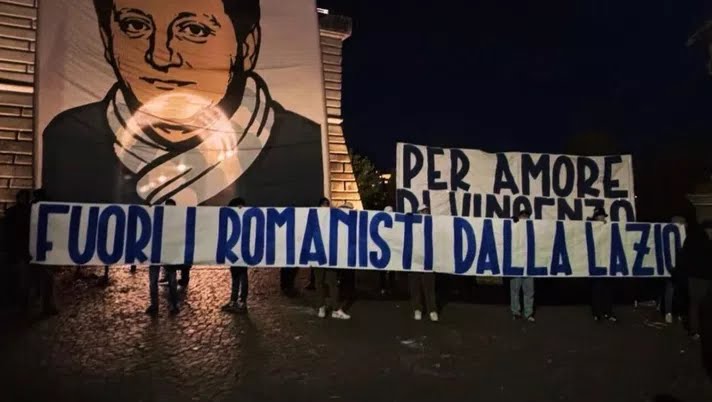
In the days leading up to the game, the atmosphere around the club had shifted. My understanding was that there had been controversy during the Cagliari match — specifically the club’s refusal to allow Vincenzo Paparelli’s relatives onto the pitch for the pre-match tribute.
For many Laziali, Paparelli isn’t just a name from the past; he’s a symbol, a wound, a reminder of what football can take away. Denying his family that moment felt wrong, and the Curva Nord made their feelings clear.
The Ultras released a statement announcing they would boycott the Curva, urging fans not to enter the Nord as a sign of protest and other parts of the stadium as well. That left people like me with a rare and uncomfortable dilemma:
Follow the team as always, or stand with the Curva in silence?
So there I was, a few days before kick-off, still trying to decide what to do.
Who was Vincenzo Paparelli
Vincenzo Paparelli was a devoted Lazio supporter who tragically became a symbol of the club after his death during the Rome Derby on 28 October 1979.
While sitting in the Curva Nord with his wife and waiting for kick-off, he was struck and killed instantly by a marine flare fired from the Roma end — a shot launched more than 100 metres across the Stadio Olimpico.
Paparelli wasn’t involved in any violence; he was simply a fan there to watch his team. His death shocked Italian football, leaving a lasting scar on the Derby della Capitale and becoming a moment of deep collective mourning for all Laziali, who continue to honour his memory with respect and devotion.
What the Boycott Was About
The boycott for Lazio–Lecce stemmed directly from what happened before the previous home match against Cagliari.

The Curva Nord had prepared a special tribute for Vincenzo Paparelli, with his 13-year-old granddaughter originally accredited to go down onto the track to symbolically “launch” the choreography.
But at the last moment, the club blocked her and her mother from entering the pitch area, reclassifying them as “VIP/Tribuna” and denying them access. For the ultras, this wasn’t a simple logistical mix-up — it was a deep insult to Paparelli’s memory and to the supporters who had organised the tribute.
In their statement, they announced they would not enter the Curva Nord for the Lecce match, calling the protest “for the love of Vincenzo, for the love of Laziali,” and urging fans to leave the sector empty. The result was a surreal sight: a practically deserted Curva Nord, its silence louder than any chant.
Why This Mattered to the Ultras — and Why They Escalated to an Empty Curve
For many Lazio supporters, especially those in and around the Curva Nord, the legacy of Vincenzo Paparelli goes far beyond a name in the club’s history.

It represents identity, sacrifice, and a bond that runs through generations of Laziali. Allowing his granddaughter to take part in the tribute wasn’t just a symbolic gesture — it was a continuation of that legacy, a way for the community to honour one of its most painful stories.
So when the club refused her access to the track, the ultras didn’t see it as a simple administrative decision. They saw it as a denial of something sacred.
The boycott, then, became a form of resistance — a deliberate decision to replace the usual thunder of the Curva with an uncomfortable silence. An empty sector inside a busy stadium is a powerful statement, and that was the point: to force the club to confront the emotional weight of Paparelli’s memory and to demand respect on the supporters’ terms.
Ultimately, this wasn’t about one blocked tribute. It was about trust, identity, and generational memory — the pillars that define what supporting Lazio means for so many.
What Emerged Afterwards — Reactions & Tensions
The boycott triggered an immediate and sharp response from the club. Claudio Lotito came out publicly insisting he would “not accept intimidation,” framing the protest as exaggerated and unjustified.
His comments only added fuel to the fire, reinforcing the sense that the gap between management and the curva was widening rather than closing.
Among supporters, though, the reaction was very different. Across social media and inside the wider fanbase, the gesture resonated strongly — not only with the ultras, but also with many more moderate Laziali who felt the refusal of Paparelli’s granddaughter was part of a broader disconnect between the club’s leadership and the values supporters hold dear.
And the result was there for all to see. Against Lecce, the Curva Nord — usually the heartbeat of the Olimpico — was almost completely empty. No flags, no chants, no choreography. Just a rare and uncomfortable silence. In a stadium where noise is part of the identity, that quiet became its own statement.
The Meaning Behind the Boycott
The anger that exploded after the Cagliari match had nothing to do with football and everything to do with dignity, memory, and what Vincenzo Paparelli represents to Lazio’s identity.
When the club blocked his granddaughter from stepping onto the track to trigger the planned choreography, the Curva Nord didn’t see a simple logistical issue — they saw a betrayal.
In their statement, the ultras made it clear:
“They stopped us from honouring Vincenzo Paparelli less than a day before the match.”
For them, Paparelli isn’t a symbolic figure to be wheeled out when convenient. He’s an open wound, a story passed down like family history. As they wrote with unmistakable emotion:
“For us, Paparelli isn’t just a name — he’s family.”
And missing a match, they admitted, would “hurt,” but his memory was worth more than any 90 minutes.
So the boycott of the Lecce game was framed not as rebellion, but as devotion. An act of love, not defiance. They refused to bow to what they described as “blackmail,” insisting, simply and firmly:
“We won’t go into the stadium.”
Leaving the Curva Nord empty would be “painful,” they said, but it was the only moral choice.
“Staying outside is painful, but it’s the right thing to do for Vincenzo.”
And with that, they called on all Laziali to stand with them — “not to be part of what the club has done.”
My Decision
I spoke to a few friends, but if I’m honest, I had already made up my mind.
Silvia said something that stuck with me: she hates Lotito, but she loves Lazio more. And she’s right — that’s the eternal conflict for so many of us.
On X (formerly Twitter), an international fan, Kilkito, a fellow season ticket holder living in Scotland, posted that even though he had booked flights and a hotel and was travelling with his dad, he would still come to Rome — but he would not enter the stadium. That kind of sacrifice hits differently. It makes you stop and think about what loyalty actually means.

In the end, even though it meant I wouldn’t be inside the ground, I knew what I had to do. I decided it was only right to join the protest and boycott the match.
I didn’t travel down to Rome to stand with my Lazio brothers and sisters at Ponte Milvio, but I took my stand all the same — by refusing to enter the stadium. Sometimes support isn’t about being present. Sometimes it’s about knowing when to stay away.
Lazio e Libertà — the Exception That Sung
One notable exception to the protest came from Lazio e Libertà, the left-wing Lazio supporters’ group known for their social activism and anti-fascist stance.
Unlike the Curva Nord, they chose not to join the boycott. Instead, they entered the stadium and continued singing throughout the match, determined — in their words — to “support the team regardless of the club’s actions.”
Their decision didn’t go unnoticed. For many ultras, especially those in the Curva Nord, it felt like a fracture in what should have been a united front. With the North Stand deliberately left in silence, the sound of Lazio e Libertà singing from their section cut through the emptiness — a reminder that not all supporters agreed on how to honour Paparelli or how best to protest the club’s decision.
While Lazio e Libertà framed their choice as loyalty to the squadra above all else, the ultras viewed it as disappointing, even disrespectful, believing this was a moment where unity should have mattered more than anything else.
The contrast between silence and song became one more symbol of the tensions rippling through the fanbase during a week already defined by division.
The Match
In a week dominated by off-pitch tension and the eerie silence of a stadium without its organised support, Lazio responded in the most reassuring way possible: with a calm, controlled, fully deserved 2–0 win over Lecce.
For once this season, it wasn’t chaos, it wasn’t drama, and it wasn’t survival mode. It was structure, patience, and two moments of pure quality — first from Matteo Guendouzi, then from Tijjani Noslin.
From the opening minutes, Guendouzi played like a man determined to drag Lazio through the uncertainty.
With the Curva Nord empty and the Olimpico strangely muted, he stepped into the silence and made it his stage. He demanded every ball, carried the team up the pitch, broke Lecce’s attempts to press, and dictated the tempo with the authority of a midfielder completely in control.
His goal — the opener — arrived exactly when Lazio needed it. Timing his movement perfectly, he met the loose ball on the edge of the box and struck it low into the corner with precision and conviction. A midfielder’s finish: clean, composed, and full of belief.
But it wasn’t just the goal. This was Guendouzi at his absolute best — linking midfield and attack, covering ground for teammates, snapping into tackles, and playing with the intensity Lazio have often lacked during this turbulent spell. It felt like the night he said, “If no one else will lead, I will.”
And if Guendouzi set the tone, Tijjani Noslin delivered the exclamation mark. His goal was pure Noslin: direct, explosive, and ruthless. He timed his run, bullied his defender with that muscular burst of acceleration he’s becoming known for, and finished with his head after the keeper had saved to make it 2–0. A striker’s goal, simple and devastating.
From there, Lazio managed the game with maturity. Lecce were reduced to hopeful half-chances, the tempo stayed under control, and for the first time in weeks, the team looked calm — almost peaceful — amid the chaos swirling around the club.
It was a night defined not by noise, but by professionalism.
And at the centre of it all was Matteo Guendouzi: the heartbeat, the driving force, and the man who made sure Lazio got the job done.
Conclusion
Lazio vs Lecce was never really about Lecce. It wasn’t even about the three points, or bouncing back after Inter, or whether Guendouzi could drag us through ninety tense minutes. This match, more than any other this season, became a mirror held up to what it means to support Lazio — the contradictions, the conflicts, the loyalty, the pain, the love, and the endless negotiation between club and community.
The weeks leading into this game reminded me of something simple but often forgotten: football isn’t just played on the pitch. It lives in memories, in wounds carried for decades, in gestures that matter because they connect us back to the people who came before. The anger around the Paparelli tribute wasn’t manufactured; it was the kind of anger born from love — the kind that only exists when something sacred feels mishandled.
The decision of the Curva Nord to leave the stand empty created a silence louder than any choreography. That absence told its own story: a fanbase that felt unheard, disrespected, and pushed into making a choice no one truly wanted to make. And even among Laziali, there was division — from Lazio e Libertà choosing to sing as normal, to people like Kikilto travelling all the way to Rome only to boycott, to supporters like me who stayed away entirely. Different choices, same heart.
Yet on the pitch, the players delivered a performance that cut through all of that. Calm, controlled, professional. Guendouzi playing like a leader. Noslin reminding us what a proper No. 9 can do. A 2–0 win that, under any other circumstances, would have been celebrated with noise, flags, and the usual chaos of a Roman night.
Instead, the celebrations were muted. The echoes hung in the Olimpico in a way that felt almost uncomfortable — a reminder that the relationship between the fans and the club is at a fragile moment.
But maybe that’s why this night mattered. Because it forced everyone — players, ultras, casual fans, even people like me — to confront what Lazio really means to us. It’s passion, yes. It’s beauty, yes. But it’s also identity, memory, and a constant fight to protect the things we believe make this club special.
I didn’t step inside the stadium for this one. And weirdly, the silence felt right. Not easy. Not enjoyable. But right.
Sometimes supporting Lazio isn’t about being there. Sometimes it’s about choosing to stand on the outside, hoping — always hoping — that things will get better, that the club will listen, and that one day the Curva Nord will roar again for the right reasons.
And at the next home game, I’ll be there.



2 Comments