
For many football fans, loyalty is measured in seasons, trophies, or a single stadium seat.
For others, it is measured in miles, rituals, and the stories collected along the way.
My journey with Lazio began unexpectedly, far from Rome, and has since grown into a lifelong pursuit of devotion.
From the moment I stepped onto the Curva Nord in 2003, to the current ambition of following Lazio home and away across an entire Serie A season, this is a story of passion, discovery, and the intensity of Italian football culture.
Where it all began
My passion for Lazio can be traced back to a single day: 26 January 2003, when I stepped into the Stadio Olimpico for the first time.
Lazio were playing Reggina, a fixture that might not have stood out to most neutrals; but for me it was transformative.
Emiliano Bonazzoli scored the only goal in a 1–0 win for the visitors, yet the result was secondary to what unfolded around me.
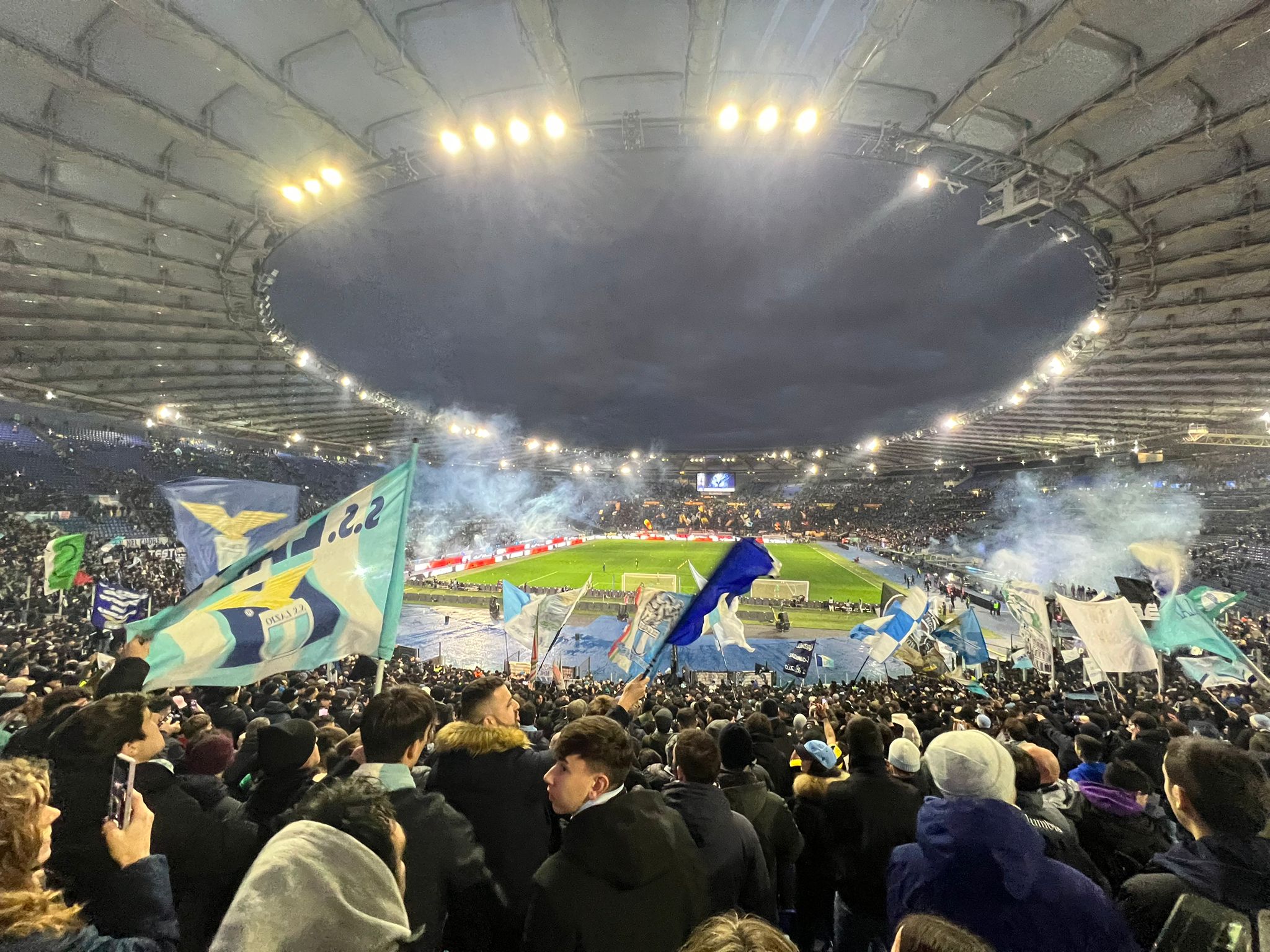
I had found my way onto the Curva Nord, and nothing in my years of following football in England had prepared me for what I experienced.
The noise was constant, the colours were spellbinding, and the atmosphere almost overwhelming.
Midway through the first half, with the ball rolling out of play after a foul, the referee blew his whistle. The ball headed towards the Lazio bench, where Roberto Mancini—immaculate in his sharp suit—stepped forward.
With one effortless swing, he volleyed the ball back towards the centre circle, straight into the hands of Jaap Stam. The Curva erupted as one, belting out “Roberto Mancini eh oo, Roberto Mancini eh oo.”
That was the moment. The combination of theatre, elegance, and raw passion struck me in a way no match ever had before. In that instant, I fell in love—not just with Lazio, but with the living, breathing culture of football in Rome.
Why Lazio?
People often ask me why I support Lazio. Is it because of Paul Gascoigne, the English connection that drew a number of British fans towards the club in the 1990s?
The answer is no.
My story begins in Latina, a city just south of Rome, where I was working as an English teacher during the 2002–03 academic year.
One day, my student—now close friend and Lazio brother—Valentino came into class with a mischievous grin.
“You hate Luton, don’t you?” he asked.
Surprised, I replied, “Yes, how do you know that?”
He pulled out a copy of La Voce della Nord, the Lazio fanzine, and pointed to an article on English derbies. Among them was the Watford–Luton rivalry. The connection was instant.
A week later, Valentino couldn’t make it to the match and asked if I wanted to use his abbonamento (season ticket).
Back in 2003, there was no need to show ID—Italian football was a different world. I said yes, and from that moment I was hooked.
For the rest of the season, I travelled up to Rome for Lazio’s home games, experiencing the Curva Nord in full voice. I even went to Roma away, my very first Derby della Capitale, an unforgettable baptism into one of football’s fiercest rivalries.
The following summer, I moved to Rome permanently and bought my own season ticket.
What began as a chance offer from a student had turned into a lifelong bond. Lazio was no longer just a team; it was part of my life, my friendships, and my identity.
A challenge reignited
Two decades later, that spark remains the driving force behind a new personal quest: to follow Lazio, home and away, across an entire Serie A season.
It’s not my first attempt at such a feat. Back in 2000–01, having just returned from travelling the world, I set out to complete a full campaign with Watford.
I came agonisingly close, managing 44 of the 46 fixtures, but fell just short of perfection.
Ever since, I’ve carried the feeling of unfinished business. Now, with Lazio, the target is bolder and cleaner: 38 out of 38.
This is more than just ticking matches off a list. It’s about fully committing to the rhythm of a season, embedding myself in the life of a club, and embracing the grind as much as the glory.
The road trips
Italy’s geography makes the challenge a serious undertaking. Following Lazio means endless hours of travel: flights to Sardinia for Cagliari, long train rides north to Udine, Bergamo, or Turin, and the high-speed dash to Milan.
Each journey brings with it logistics, expenses, and time pressures. Balancing the demands of work with nine months of near-constant travel is its own test of endurance.
Yet these trips are part of the romance. Every away-day is an immersion into another city’s culture, another stadium’s character, another rivalry’s intensity.
Visiting Sassuolo might feel modest compared to Rome, but even a smaller stadium carries its own personality—the local tifosi proud, the streets surrounding the ground alive with colour and noise.
Trips to Naples or Milan bring the full spectacle of Italian football: the city buzzing with anticipation, rival fans in tense standoffs, and the stadiums themselves towering monuments of passion.
Some away days linger in memory more than others. I remember hearing about the 2000 Scudetto campaign, where Lazio travelled to Cagliari and the Curva Nord fans followed with relentless banners and chants, turning the away section into a fortress of devotion.
Travelling to every Lazio fixture from Florence adds another dimension to the challenge.
The high-speed trains, regional connections, and occasional flights make each away-day a mini-journey in itself.
Yet that distance also allows time to reflect on what it means to be a devoted supporter: the anticipation builds on the way there, the camaraderie among fellow travelling fans intensifies the experience, and the return journey is a moment to digest the highs and lows of the match.
Each trip, whether it’s a short hop to Rome or a marathon journey north to Udine or south to Cagliari, becomes part of the story.
It’s a season-long adventure, a collection of memories, and a testament to the patience, endurance, and passion required to follow Lazio completely, home and away.
Domenica Bastardi
Integral to the culture of the Curva Nord is the phrase “Domenica bastardi”, literally translating to “Sunday bastards.”
This banner and chant are often displayed during matches to provocatively address Lazio’s city rivals, A.S. Roma, signaling that the true focus is on the upcoming derby.
The rest of the week’s fixtures—even European ties—are, in Lazio fans’ eyes, merely preludes to the Derby della Capitale.
Its origins are rooted in ultras culture and can be traced to at least 2013, during a Lazio vs Legia Warsaw match when a banner read “A domenica bastardi”—a pointed taunt at Roma.
For Laziali, it’s a reminder that nothing before Sunday truly counts; the real confrontation, the one that defines a season, is always the derby.
It’s not just a joke or a chant—it’s a declaration of identity, loyalty, and rivalry intensity. “Domenica bastardi” encapsulates the razor-sharp focus and emotional weight that shapes the life of a Lazio supporter.
The Derby della Capitale
No journey with Lazio is complete without experiencing the Derby della Capitale in full.
More than a football match, it’s a cultural phenomenon that divides and unites Rome simultaneously.
To the Laziali, winning the derby is often more important than points on the table—it’s about pride, legacy, and identity.
For a supporter chasing 38 games, these matches are emotional peaks.
The anticipation builds for weeks, the choreography in the Curva Nord is at its zenith, and every chant resonates with decades of history.
Experiencing both derbies within a season-long odyssey is a way of touching the very heart of what it means to be a Lazio fan.
The costs of devotion
There’s no hiding from the practicalities: this challenge comes with a high price. Tickets, travel, accommodation, and the hidden costs of meals and time all add up.
Following a club across Italy is not the cheapest way to spend a season. Then there’s the personal toll—late nights, early mornings, and the constant juggling act between everyday responsibilities and the demands of football.
But football fandom has never been about efficiency. It’s about emotion, loyalty, and the stories you collect along the way.
If the cost is high, so too is the reward: the memories of last-minute winners, the sight of a packed away end celebrating on foreign turf, the friendships forged in the grind of the season.
Writing the next chapter
To achieve all 38 fixtures would be more than a personal milestone—it would be the culmination of a journey that began on that January afternoon in 2003.
I might fail this challenge at the first hurdle but I am going to give it my best!
The first stop will be Como away followed by Verona at home before Sassuolo then the home derby!
Football is not only about the players or the results, but about the stories supporters carry with them: the sacrifices, the travels, the songs, and the shared sense of belonging.
This challenge is about adding my own story to Lazio’s. From Mancini’s volley to the dream of a perfect season, from the first Domenica bastardi banners witnessed in the Curva Nord to the miles travelled from Florence and previously England and Ireland, it’s a thread of passion that has stretched across two decades.
The road ahead will be long, expensive, and exhausting—but if it ends with me completing the full odyssey, it will have been worth every kilometre, every train ride, every cheer, and every sigh.
Because some loves begin with a single spark, and if nurtured long enough, they burn for a lifetime.
Share this:
- Share on Bluesky (Opens in new window) Bluesky
- Email a link to a friend (Opens in new window) Email
- Share on Facebook (Opens in new window) Facebook
- Share on Reddit (Opens in new window) Reddit
- Share on Threads (Opens in new window) Threads
- Share on WhatsApp (Opens in new window) WhatsApp
- Share on X (Opens in new window) X
Related

Must See
-


Features
/ 2 months agoEXCLUSIVE INTERVIEW: Marc White on Dorking Wanderers’ rise from park football to global screens and their future aspirations
Dorking Wanderers, a National League South side with international recognition, are taking the social...
By Jameel Mulla -


Boxing
/ 2 months agoTop five sporting events of 2025: From Rory McIlroy finally winning the Masters, to England Women’s Rugby World Cup triumph and more
It’s been another remarkable 12 months of sport that has provided plenty of entertainment...
By Ben Potts -


50 Shades of May
/ 4 months agoFSOM: Grassroots football is dying on its a*** and we should be very concerned – here’s why I give the recreational game 10-15 years max
Sometimes when you poke a dead horse with a pointy stick a miracle occurs...
By John May


1 Comment