
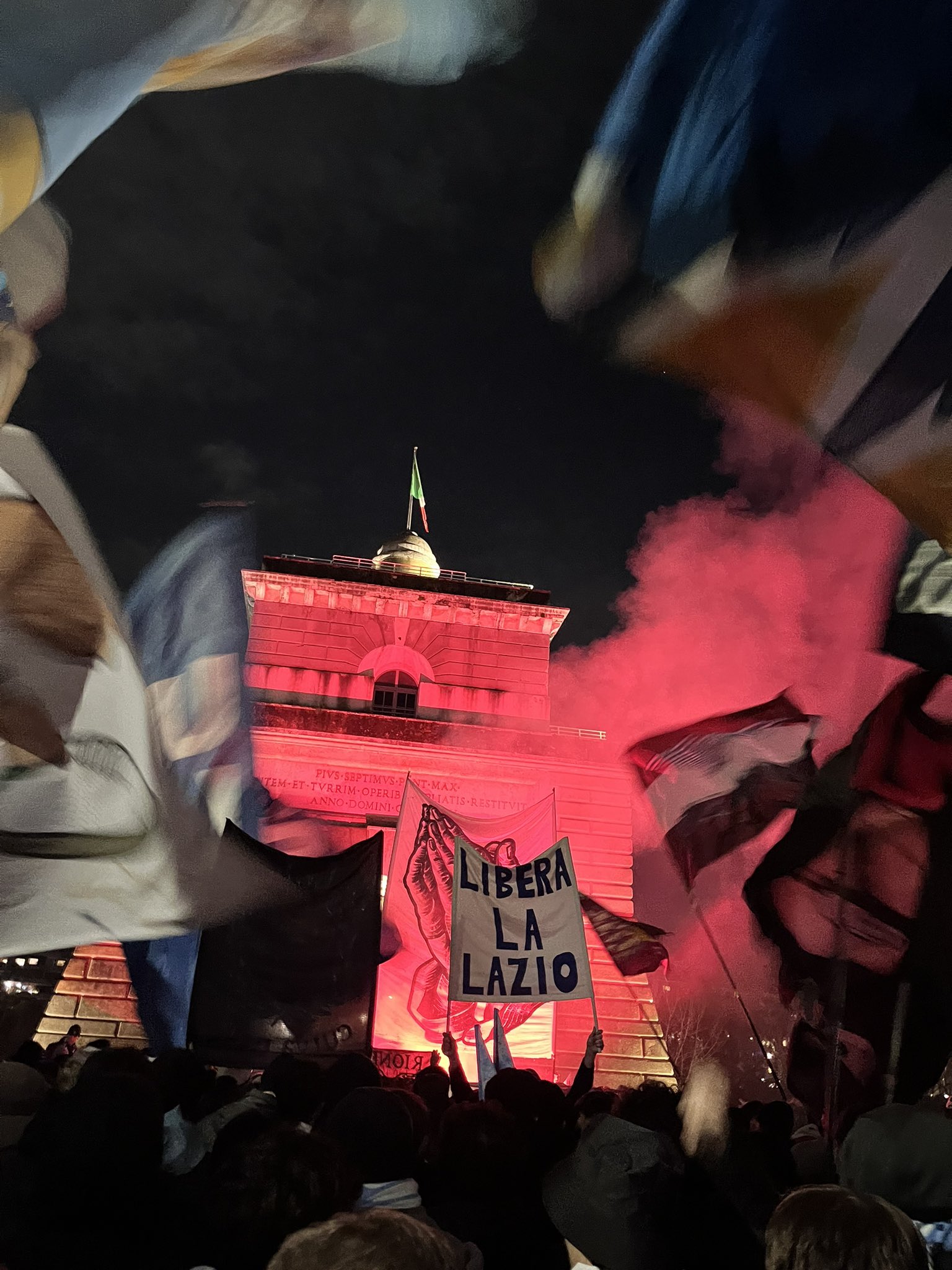
There is a strange contradiction at the heart of Lazio as the 2026-27 Serie A season prepares to begin.
At the Stadio Olimpico, thousands of seats that would normally be occupied by some of Italy’s most passionate supporters are set to remain empty.
Yet when Lazio begin their Serie A campaign in Bologna, thousands of Laziali will be there.
The away allocation of 2,480 tickets disappeared within minutes and reports suggest more than 3,500 Lazio supporters, potentially approaching 4,000, are expected to make the journey to Emilia-Romagna.
It tells you almost everything you need to know about the boycott.
Lazio supporters have not abandoned Lazio.
They are attempting to abandon Claudio Lotito.
How did it reach this point?
The relationship between Lazio’s organised support and president Lotito has been deteriorating for years, but the current stadium boycott can be traced directly to January 2026.
Ahead of Lazio’s home match against Genoa on 30 January, the Curva Nord called on supporters to leave the Olimpico empty.
The organised groups described a situation increasingly compromised by what they regarded as “total mismanagement”. Lazio themselves responded angrily, condemning the call to boycott the Genoa match.
What initially appeared to be another chapter in the long and difficult relationship between Lotito and the Lazio support quickly became something much bigger.
Home matches were boycotted during the second half of the season. The Curva Nord was repeatedly left empty.
By the summer, the protest had evolved from a dispute about performances and transfers into a fundamental rejection of the ownership.
The message became simple:
More than 20,000 supporters subsequently took that message onto the streets of Rome in July. The remarkable sight of thousands of Laziali marching together demonstrated that the empty Olimpico should not be confused with apathy. One report described the boycott as an “extreme act of love”.
Why are Lazio supporters boycotting?
It would be easy to describe this simply as supporters being unhappy because Lazio have not bought enough good players.
That no longer really explains it.
There are certainly sporting grievances.
Supporters have become frustrated by what they see as a lack of ambition, insufficient investment, poor management and the failure to build consistently on Lazio’s periods of success.
But the dispute has become much broader.
For the organised support, the problem is now Lotito’s entire stewardship of the club and what they believe Lazio have become under his ownership.
A recent Curva Nord message made the position particularly clear. The groups said they were not fighting for new signings, results or even a new stadium. Their demand was “freedom” and a change in the way Lazio is run.
In other words, signing three or four players is unlikely to end this.
For those leading the boycott, the issue is no longer the transfer market.
It is the ownership itself.
What have the Lazio supporters announced?
In June, the organised groups published what amounted to a blueprint for the 2026-27 protest.
They announced that they would not renew their season tickets and would stay away from Lazio home matches in Serie A and the Coppa Italia.
They accepted that this meant losing the right to seats some families and supporters had occupied for decades.
At the same time, they made another crucial promise.
They would follow Lazio away.
The groups specifically said they intended to attend away matches and support the players, stressing that the dispute was not with the team or the coach.
They also announced that they would attend both home and away Rome derbies, while supporters were encouraged to cancel subscriptions to pay-TV services showing Lazio and instead watch home games together in Lazio-supporting bars, restaurants and pubs.
That distinction matters.
This isn’t a boycott of Lazio.
It is an attempt to financially and visually boycott the Lazio ownership while continuing to support the football team whenever possible.
The season ticket numbers are extraordinary
Perhaps the clearest indication that this protest extends far beyond a few hundred ultras is the season ticket campaign.
Last season Lazio sold 29,918 season tickets.
Earlier this summer, only around 2,000 had been renewed, meaning roughly 93% of the previous season-ticket base had initially refused to return. That astonishing collapse was even reported internationally by Spanish newspaper AS.
With the campaign now reaching its conclusion, reports put the total at approximately 4,000 season tickets.
Even allowing for the increase from the initial renewal phase, that means around 26,000 fewer season tickets than last season.
It is one of the worst season-ticket campaigns of the Lotito era.
For context, Lazio had sold around 30,000 season tickets in each of the previous three seasons.
Whatever anyone thinks about the methods being used, the numbers demonstrate something important.
This isn’t simply an ultras protest anymore.
A huge section of the wider Lazio support has followed them.
Bologna proves the fans haven’t abandoned the team
If anyone still believes Lazio supporters have simply lost interest, Bologna provides the answer.
Lazio open their Serie A campaign at the Stadio Renato Dall’Ara on Monday and demand from the travelling support has been enormous.
The official away allocation contained 2,480 tickets.
They sold out within minutes.
More than 3,500 Lazio supporters are expected in Bologna, with estimates around the travelling support approaching 4,000 once Laziali sitting outside the official away section are considered.
This follows strong Lazio support during the summer friendlies in Ascoli and Frosinone.
The message could hardly be clearer.
Empty at home.
Packed away.
It is a remarkable form of protest because the supporters are attempting to separate the institution they love from the ownership they oppose.
They want the players to know they have not been abandoned.
Bologna should make that obvious.
Why did the fans return for Milan and the Coppa Italia final?
One criticism of the boycott last season was that the supporters occasionally broke it.
The two most obvious examples were the home game against Milan and the Coppa Italia final against Inter.
But those occasions also demonstrated that the Curva Nord regarded the boycott as something it controlled rather than an absolute refusal ever to enter the Olimpico again.
For the Milan game in March, the organised groups explicitly suspended the boycott for one match and called Lazio supporters back to the stadium. Around 50,000 were expected and the Curva returned with its usual colour and choreography.
The Coppa Italia final was another exception.
Lazio had reached their first Coppa Italia final since 2019 and the organised support decided that a final was bigger than the dispute. They returned to support the team against Inter.
Those nights are important when trying to understand what could happen this season.
The groups’ June statement specifically said they would return “when we decide” and confirmed that the derby would be an exception.
So an empty Olimpico does not necessarily mean an empty Olimpico for every single Lazio match.
If there is a game the organised support believes transcends the boycott, history suggests they could temporarily return.
Will the boycott last all season?
At the moment, there is little evidence that the supporters are preparing to end it.
If anything, the opposite appears true.
The season-ticket numbers show extraordinary commitment to the protest. Giving up a season ticket is considerably more difficult than missing one or two matches.
Many supporters have surrendered seats they have held for years.
The organised groups have also made their objective increasingly explicit.
They want fundamental change at Lazio.
That makes it difficult to imagine a couple of victories or a late transfer-window signing suddenly filling the Curva Nord again.
Unless there is a significant development in the relationship between Lotito and the supporters, the most likely scenario is that the boycott continues through the season, with selected exceptions decided by the organised groups.
The derby is already an announced exception.
Other exceptional matches could potentially be treated similarly.
But the default position remains the same:
No home games.
The boycott has gone international
What makes this protest particularly interesting is how far the story has travelled.
For years the conflict between Lotito and sections of the Lazio support was largely treated as an Italian football story.
Not anymore.
Spanish newspaper AS reported on the extraordinary collapse in season-ticket sales, describing supporters emptying the Olimpico and highlighting the scale of the July demonstration.
British and Irish media have also covered the prospect of Lazio playing in front of an almost empty 70,000-seat stadium, with reports focusing on the dramatic fall from almost 30,000 season-ticket holders to only a few thousand.
English-language coverage in Rome has similarly highlighted the organised groups’ decision to boycott season tickets, merchandise and pay-TV subscriptions.
The pictures help explain the international interest.
A club with Lazio’s history playing in front of an empty Curva Nord is visually extraordinary.
Then seeing thousands of those same supporters appear at an away match makes the story even more striking.
What do other football fans think?
Reaction outside Lazio has inevitably been mixed.
There has been mockery.
Milan supporters, for example, joked after the new boycott was announced that the Olimpico would suddenly become a “Bombonera” again when Milan came to town, a reference to the decision to suspend the previous boycott for Lazio-Milan.
That criticism is understandable.
A boycott is inevitably more powerful when there are no exceptions.
But there has also been considerable admiration for what Lazio supporters are doing.
Discussion among Italian football supporters online has focused particularly on the extraordinary season-ticket figures and the willingness of supporters to hit the club financially despite knowing that it also removes something important from their own lives. Some Lazio supporters argue that refusing tickets is the only meaningful way left to put financial pressure on Lotito.
You do not have to like Lazio or its ultras to understand the power of 25,000-plus people effectively saying: enough.
Other supporters will disagree with the tactics.
Some will argue that you should always support your team, regardless of who owns it.
But Bologna exposes the weakness in that argument.
The Lazio support is still following the team.
They are simply choosing where to do it.
Why I decided to follow the boycott
For me, this isn’t an abstract argument.
I had a decision to make this summer.
Do I renew my Lazio season ticket and continue travelling to Rome for home matches, or do I follow the organised support and stay away?
I decided not to renew.
That wasn’t an easy decision.
Going to Lazio is part of my life. The journey to Rome, walking towards the Olimpico, meeting other Laziali, standing in the Curva and watching the eagle fly before kick-off are experiences that become part of your routine and your relationship with the club.
It hurts knowing Lazio will be playing at home and I won’t be there.
There will undoubtedly be Saturdays and Sundays this season when I question the decision.
But ultimately I felt that if I believed the boycott was justified, I had to follow it.
There is little point agreeing with a protest and then continuing to give the club my money every other weekend.
So I won’t travel to Lazio’s home matches while the boycott continues.
Instead, I will try to do as many away games as I can.
For me, that is the important distinction.
I haven’t stopped supporting Lazio.
I am supporting Lazio while refusing to support the way Lazio is currently being run.
Thousands of other supporters appear to have reached exactly the same conclusion.
Conclusion: Lazio without the Laziali
Lotito has survived protests before.
He has owned Lazio since 2004 and confrontation with supporters is hardly new.
But this feels different.
Not because the Curva Nord is angry.
That has happened before.
It feels different because of the scale.
Around 30,000 season-ticket holders last year have become roughly 4,000 this summer.
More than 20,000 people marched through Rome.
The Curva Nord intends to remain empty.
And yet thousands are preparing to descend on Bologna.
That is what makes this boycott so powerful and, at the same time, so painful.
The easiest accusation to make against supporters who stay away is that they have deserted their club.
Bologna proves otherwise.
Lazio’s supporters are still there.
They will be on trains, in cars and coaches travelling across Italy. They will fill away sections. They will sing for the shirt and the players.
But when Lazio return to the Olimpico, thousands will deliberately stay outside.
For supporters like me, that will hurt.
Perhaps it is supposed to.
Because the entire idea behind this boycott is that something we love has reached a point where simply carrying on as normal no longer feels acceptable.
Whether it lasts three months, six months or the entire season will ultimately depend on what happens next.
For now, though, the message from the Lazio support could scarcely be louder.
Even when the Curva Nord is completely silent.
Share this:
- Share on Bluesky (Opens in new window) Bluesky
- Email a link to a friend (Opens in new window) Email
- Share on Facebook (Opens in new window) Facebook
- Share on Reddit (Opens in new window) Reddit
- Share on Threads (Opens in new window) Threads
- Share on WhatsApp (Opens in new window) WhatsApp
- Share on X (Opens in new window) X
Related

Must See
-


Features
/ 5 days agoWhy England CAN win Euro 2028 – and what will be the difference to erase years of previous pain
England have been waiting a long time for a major international trophy. To not...
By Matt Smith -


Football
/ 5 days agoLionel Messi scores in his Argentina farewell during 3-0 friendly win over Benin – in emotional Buenos Aires swansong
Lionel Messi’s final match in an Argentina shirt ended on a high as he...
-


Football
/ 2 weeks agoManchester City found GUILTY of 114 charges of breaking Premier League financial rules
Manchester City have been found guilty by the Premier League of breaching 114 out...


