If Italian football has long revered charismatic, trophy-laden coaches, then Gian Piero Gasperini stands apart as one of the great innovators of his generation—yet also an under-celebrated one in the traditional “great coach” pantheon.
His journey from solid midfield journeyman to tactical architect of one of Serie A’s most thrilling projects reflects both persistence and bold thinking.
With his 2025 appointment at AS Roma, Gasperini enters a new chapter: the question now is not what he has done, but whether he can turn a new page and cement his status among Italy’s elite managers.
Playing Career
Born 26 January 1958 in Grugliasco, Italy, Gasperini emerged from the youth system of Juventus FC, joining the club’s ranks as a nine-year-old and progressing through the Primavera (youth) ranks.
Although he made a handful of senior appearances in the Coppa Italia for Juventus, his career as a player was in the main built around mid-to-lower-tier Italian sides.
He played as a midfielder, tallying some 468 senior appearances and one goal across clubs including Reggiana, Palermo, Cavese, Pistoiese, Pescara and Salernitana.
While not a headline name, Gasperini’s playing days gave him a solid grounding in Italian football’s rigours and the structural realities of the professional game.
The Rise of the Manager
Gasperini’s managerial career began in the youth ranks at Juventus before stepping into senior roles in the early 2000s.
His first significant professional job came at FC Crotone (2003–04, 2005–06) where he earned promotion from Serie C1 to Serie B.
At Genoa CFC (2006–10 and again 2013–16), he took a club recently returned to Serie A and produced strong finishes—including a 5th-place finish in 2008-09, Genoa’s highest in nearly two decades.
A shorter and less successful stint at Inter Milan in 2011 ended quickly, as did his time at US Palermo in 2012–13.
It was his move in 2016 to Atalanta BC that truly defined his career and raised his stock.
Achievements, Style and Legacy at Atalanta
Taking over Atalanta on 14 June 2016, Gasperini inherited a club that had spent much of the preceding years fighting relegation rather than challenging the top of Serie A.
Over the subsequent nine seasons he transformed Atalanta into a consistent force, qualified for the Champions League multiple times, and in 2024 delivered the club’s first major European trophy—the UEFA Europa League Final 2024, after beating Bayer Leverkusen 3-0.
Under his leadership, Atalanta’s hallmark became high-pressing, attacking football built on a flexible 3-4-3 (or variants thereof) formation, with overlapping wing-backs, aggressive transitions, and a compact defensive basis.
He secured multiple top-four and top-three finishes, and earned several coach-of-the-year awards (for example, the Panchina d’Oro in 2019 and 2020) which underscores his recognition amongst peers.
Why he left Atalanta: In February 2025 Gasperini confirmed that his contract would not be renewed beyond June 2025, stating that the time had come for a “beginning and an end” to that chapter.
He formalised his departure at the end of the season (31 May 2025) with a heartfelt farewell to supporters in Bergamo, admitting “I would have liked to do more” but acknowledging it was time to move on.
The Giallorossi Move: Challenges and Expectations at Roma
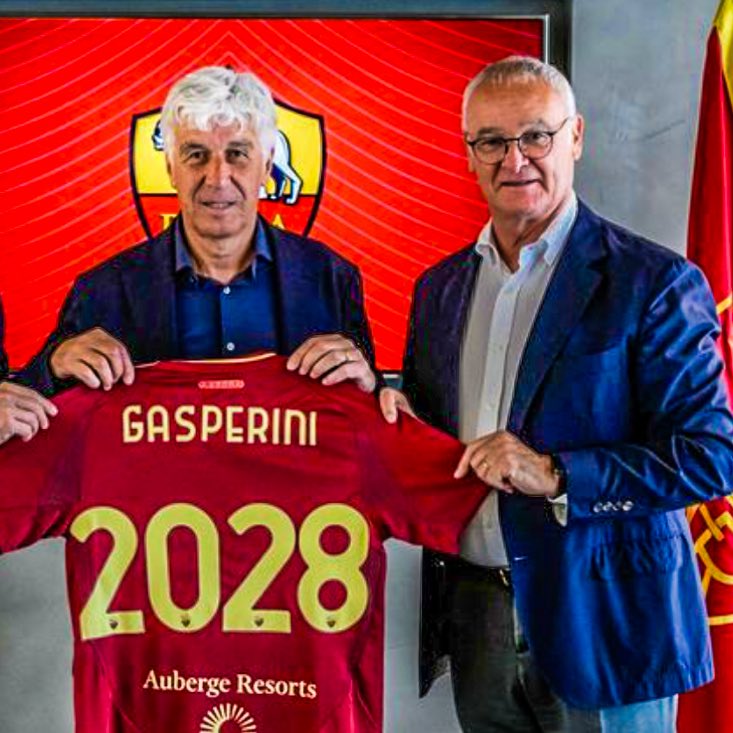
On 6 June 2025 Roma announced Gasperini as head coach, signing a contract presumably until 2028.
At Roma—in a club with large ambitions, passionate fans, and institutional pressure—Gasperini faces a different test: to turn potential into consistent trophies, to raise performance in Serie A, to restore Champions League qualification and perhaps beyond.
In his first press conference he emphasised that the role involves ambition and continuity: “What has Dan Friedkin asked of you? Regular Champions League football? Have you ever wondered why Roma haven’t been able to compete for the Champions League spots?” he asked rhetorically.
Will he succeed? The signs are encouraging: Gasperini enters with a proven track record of maximising resources, developing players, and overachieving.
However, Roma’s context is different: higher expectations, more demanding stakeholders, and less margin for error. Success will depend on whether he can impose his style swiftly, manage big-club pressure, and maintain consistency across multiple campaigns. If he does, he could cement his reputation as one of Italy’s very top coaches.
Expectations this season: The immediate goal will be to re-establish Roma among the top four, aim for Champions League qualification, and challenge for domestic trophies (Coppa Italia, Supercoppa) while implementing his playing style. Medium-term, a push for the Scudetto or deep European runs will follow.
Standing Among Italian Greats
Gasperini’s evolution from under-the-radar operator to a tactical influencer has earned him a respected place among Italian coaches.
While names like Arrigo Sacchi, Marcello Lippi, Fabio Capello and Massimiliano Allegri loom large in Italian football’s coaching pantheon, Gasperini’s work offers a modern counterpoint: innovation, player development, attacking philosophy, and sustained performance at a “mid-size” club.
If he succeeds at Roma, his standing could move from “one of the great up-and-comers” to firmly “one of the greats”.
Conclusion
Gian Piero Gasperini’s career is a testament to the power of vision, persistence and tactical clarity.
From his modest playing background to the transformation of Atalanta into a European surprise package, he has shown what smart coaching and belief can achieve.
Now, at Roma, he enters a fresh challenge and a new platform. If he can replicate the magic of Bergamo at the Eternal City, it will not only fulfil high expectations—it will elevate his status into the highest tier of Italian coaching lore.
The journey continues, and the next chapter promises to be as compelling as the last.