
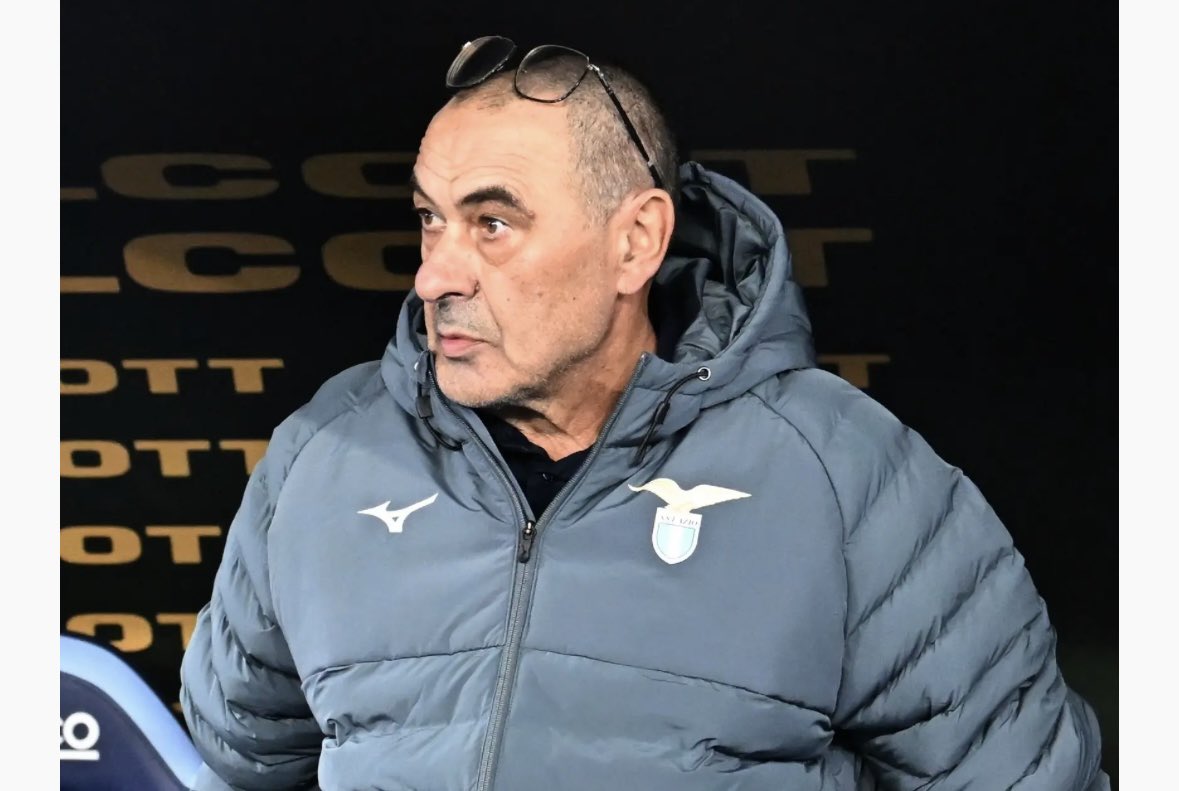
Maurizio Sarri’s career is one of the most unconventional and fascinating journeys in modern Italian football.
A former banker who rose through the amateur leagues to become one of Europe’s most recognisable tacticians, Sarri has never been a typical football manager.
His football is defined by automatisms, precision, structure and an obsession with detail that borders on the monastic.
After his first spell at Lazio — a tenure marked by flashes of brilliance, moments of frustration and a ChampionsLeague return — Sarri is now back in Rome for a second spell, determined to finish what he started.
Lazio know exactly what they are getting: a man with a clear philosophy, a meticulous training ground culture, and a belief that football is a craft, not a product.
This is the story of the coach, the thinker, the craftsman, and the returning architect of “Sarrismo.”
Playing Career: Modest Beginnings, Deep Understanding
Sarri’s playing career could not be more different from those of his coaching peers. Unlike the legends who later became managers, Sarri never reached the professional levels. He was a centre-back in Tuscany, playing semi-professionally while working full-time as a banker.
The dual life was exhausting but formative. Sarri would train evenings, play weekends, and on Monday return to spreadsheets and financial reports. He never had the athleticism to break through, but he had something else: a burning fascination with systems, movement, and the geometry of the pitch.
His modest playing background shaped him into one of the most detail-obsessed coaches in the modern game — a man who had to rely on intellect, not talent, to survive in football.
Management Career: The Ascent From the Bottom
The Amateur Climb
Sarri’s managerial journey began in the depths of the Italian pyramid — Stia, Cavriglia, Antella, Valdema, Tegoleto — unpaid jobs, muddy pitches and midweek nights under weak floodlights.
He built teams like puzzles: organised, aggressive, structured. Slowly, results came. And clubs from higher divisions began to take notice.
Empoli – The Turning Point
With Empoli, Sarri finally broke into the national conversation.
He:
- Achieved promotion to Serie A in 2014
- Built one of the league’s most admired small-budget teams
- Established a clear tactical identity based on pressing, passing and intelligent movement
Empoli under Sarri felt different — modern, daring, synchronised.
Napoli – Sarrismo is Born
Napoli was where Sarri’s ideas became iconic.
With Higuaín, Mertens, Callejón, Allan and Jorginho at the heart of the system, Napoli produced:
- Europe’s most fluid football
- A title challenge that pushed Juventus to the brink
- The famous “third man movement” automatisms
- Some of the most aesthetically admired football of the decade
They did not win the Scudetto, but they won global admiration — something almost as rare.
Chelsea – First Major Trophy
Sarri’s time at Chelsea was turbulent off the pitch but successful on it.
He won the Europa League (2019), beating Arsenal in the final, and finished third in the Premier League, despite squad limitations and an unsettled dressing room.
Juventus – A Controversial Fit but Still a Champion
Sarri’s Juventus tenure never felt natural stylistically, but he still won the 2020 Serie A title — the club’s last Scudetto to date.
It was a pragmatic year, far from “Sarrismo,” yet it proved he could win even when forced to compromise.
First Spell at Lazio: Identity, Frustration and Unfinished Business
Sarri arrived at Lazio in 2021 with the promise of modernising the team after the Inzaghi era. The journey was mixed:
Positives
- Built one of Serie A’s strongest defences for stretches of his tenure
- Guided Lazio to the Champions League knockout rounds
- Finished 2nd in Serie A in 2022–23, the club’s best finish since 2000
- Developed players including Zaccagni, Luis Alberto (in deeper role), Provedel, and Felipe Anderson
- Introduced modern automatisms rarely seen in Italy outside the top tier of coaches
Challenges
- Inconsistent squad building
- Conflicts over the transfer strategy
- Lack of depth for his demanding system
- A dressing room that occasionally resisted his intensity
- A final season defined by turnover, instability and misalignment
Sarri left frustrated — not angry, but disappointed — believing Lazio had unfinished potential.
Return to Lazio: A Second Chance to Build Legacy
Sarri’s return marks an unexpected twist — and a symbolic one. Lazio supporters, divided during his first tenure, have largely rediscovered respect for the man who delivered a second-place finish and a return to elite footballing identity.
Why the Return?
- A rebuilt relationship with the club hierarchy
- A squad now more suited to his football
- A desire for stability after managerial turbulence
- Sarri’s belief that Lazio can still become a top-four force
- Emotional unfinished business — Sarri is not a man who likes loose ends
His second spell feels more mature, more aligned, and more unified.
What Sarri Has Achieved as a Manager
- Serie A champion – Juventus (2020)
- Europa League winner – Chelsea (2019)
- Serie B promotion – Empoli (2014)
- Coach of the Year in Italy
- Iconic tactical identity (“Sarrismo”)
- Transformed Napoli into Europe’s most admired team
- Top-four finishes in multiple countries
- Multiple player developments into elite-level footballers
He is widely seen as one of the most influential tactical minds of the 21st century.
Expectations for This Season (Second Lazio Spell)
1. Rebuild the Identity
Sarri’s first goal is to restore the automatisms and fluid structure that defined his best moments at Lazio.
2. Reintegrate Key Players
Sarri will likely regain the trust of:
- Zaccagni
- Rovella
- Cataldi
- Provedel (his ideal goalkeeper)
3. Return to Europe
The minimum target: top six
The dream: Champions League qualification
4. Restore Stability and Culture
Sarri wants a Lazio with:
- Long-term planning
- Fewer destabilising exits
- A dressing room aligned with his philosophy
- Players selected for tactical suitability, not short-term needs
5. Tactical Continuity
Expect his trademark:
- 4-3-3
- Protagonist football
- Intense positional play
- Short passing structures
- Wingers attacking the half-spaces
- Jorginho-style regista role revived via Rovella
Where Does Sarri Rank Among Italian Coaches?
Italy has produced giants: Ancelotti, Lippi, Sacchi, Mancini, Spalletti, Capello, Conte. Sarri belongs to a different category: the philosopher-coach, the ideologue.
He is widely considered:
- One of the most tactically innovative Italian coaches of the last 20 years
- Among the best in Europe at system-building
- A coach whose football is studied, copied and admired
- The creator of a playing style (“Sarrismo”) — something only great coaches achieve
- A figure who elevated Napoli to near-perfection and influenced modern Italian football
Among “pure tacticians,” Sarri sits in the top three of his generation, alongside De Zerbi and Spalletti.
Conclusion: The Return of the Architect
Maurizio Sarri’s story is unlike anything else in Italian football — a man who came from the amateur leagues with a banker’s briefcase and climbed to the top with nothing but intelligence, hard work and footballing obsession.
His first spell at Lazio showed what could be possible. His return signals belief that the job is not finished — not for him, not for the club, not for the fans who came to respect the beauty of his football.
Now, armed with experience, clarity and a squad more suited to his philosophy, Sarri returns to Rome not as a gamble, but as a craftsman ready to complete the project he once began.
If this second spell succeeds, Maurizio Sarri may yet write his most defining chapter — and Lazio may rediscover the identity they have been searching for.
Share this:
- Share on Bluesky (Opens in new window) Bluesky
- Email a link to a friend (Opens in new window) Email
- Share on Facebook (Opens in new window) Facebook
- Share on Reddit (Opens in new window) Reddit
- Share on Threads (Opens in new window) Threads
- Share on WhatsApp (Opens in new window) WhatsApp
- Share on X (Opens in new window) X
Related

Must See
-


Features
/ 2 months agoEXCLUSIVE INTERVIEW: Marc White on Dorking Wanderers’ rise from park football to global screens and their future aspirations
Dorking Wanderers, a National League South side with international recognition, are taking the social...
By Jameel Mulla -


Boxing
/ 2 months agoTop five sporting events of 2025: From Rory McIlroy finally winning the Masters, to England Women’s Rugby World Cup triumph and more
It’s been another remarkable 12 months of sport that has provided plenty of entertainment...
By Ben Potts -


50 Shades of May
/ 4 months agoFSOM: Grassroots football is dying on its a*** and we should be very concerned – here’s why I give the recreational game 10-15 years max
Sometimes when you poke a dead horse with a pointy stick a miracle occurs...
By John May


