
The ongoing conflict between Israel and Gaza has increasingly intersected with international sports, prompting global debate over whether Israel should be banned from competitions.
Allegations of serious human rights violations—including claims of genocide, civilian deaths and destruction of infrastructure—have fuelled calls for suspension, while supporters and political figures argue that sport should remain separate from politics.
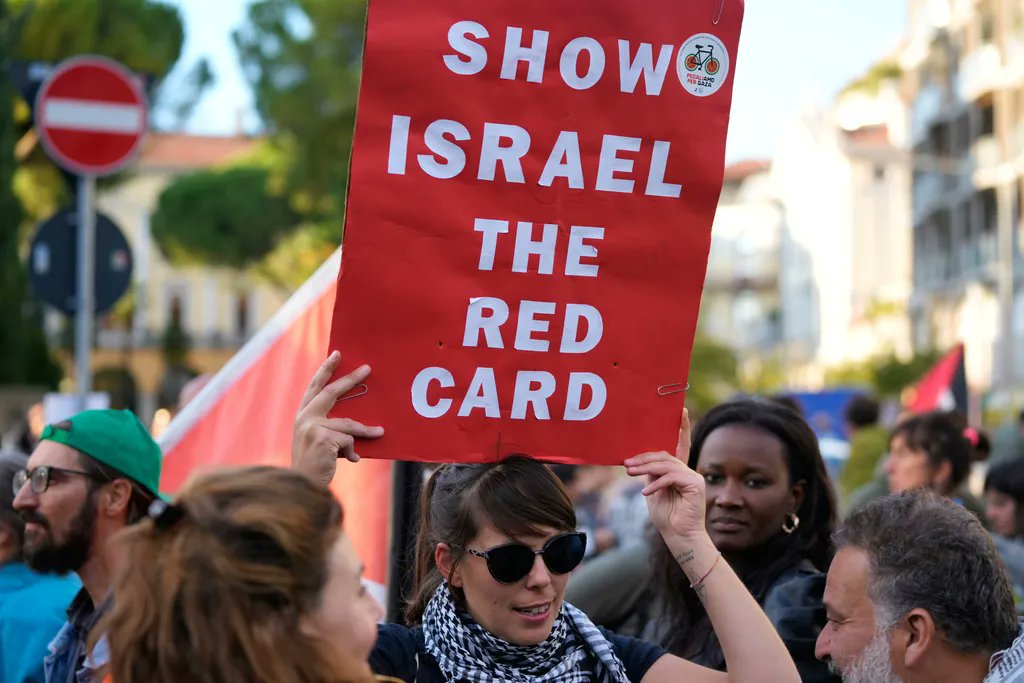
Public protests, including large demonstrations in Italy and Spain, have heightened visibility of the issue.
Comparisons have also been drawn to Russia, which faced sporting bans following its invasion of Ukraine, raising questions about consistency in the international sports community.
As of October 16, 2025, the Israel-Hamas conflict remains volatile despite a fragile ceasefire brokered by U.S. President Donald Trump. The truce, which began on October 10, has been marked by mutual accusations of violations, humanitarian challenges, and internal political tensions.
Allegations of genocide and civilian impact
Reports indicate that since the escalation of hostilities in October 2023, tens of thousands of Palestinians have died, including a significant number of women and children.
The Palestinian Sports Media Association reports that over 700 athletes, including 95 children, have been killed, and many sports facilities—stadiums, gyms, and club buildings—have been destroyed.
Journalists covering the conflict have also been casualties, with approximately 197 journalists reportedly killed, according to the Committee to Protect Journalists.
Notable figures include former national footballer Suleiman al‑Obeid, sometimes referred to as the “Palestinian Pelé,” killed while waiting for humanitarian aid, and Mohamed Salah al‑Dalou, a table tennis official killed in Gaza City.
The United Nations and human rights groups have described these events as genocide, citing the scale of civilian casualties and destruction of civilian infrastructure.
Should Israel be banned from sport?
Arguments for banning Israel cite:
- High civilian death tolls, destruction of sports infrastructure, and killings of athletes and journalists.
- Moral precedent, pointing to Russia’s suspension from FIFA, UEFA, IOC, and other federations following Ukraine’s invasion.
Arguments against include:
- Lack of definitive legal rulings under international law.
- The principle that sport should maintain neutrality and offer a channel for diplomacy or reconciliation – Risk of politicising sporting events and unfairly penalising athletes.
Former U.S. President Donald Trump has publicly opposed a ban, expressing hope that Israel would still qualify for the World Cup and emphasizing the importance of keeping politics out of sport.
International sporting bodies’ responses
- FIFA: President Gianni Infantino stated that FIFA cannot resolve political issues and emphasized the organization’s role in promoting peace and unity.
- UEFA: Considered a vote to suspend Israel but postponed it following the announcement of a proposed peace plan.
- IOC: The International Olympic Committee has maintained that Israel’s participation in the Olympics is not in doubt and stressed the importance of neutrality.
These responses show a cautious approach, balancing human rights concerns with procedural fairness and neutrality.
Public and political reactions
In Italy, widespread protests have erupted in support of Palestine.
On Tuesday, October 14, 2025, around 10,000 protesters gathered in Udine, booing the Israeli national anthem ahead of the Italy vs Israel World Cup qualifier. Across the country, demonstrations and strikes have drawn millions of participants.
A recent music festival also became a flashpoint: pro-Israel supporters see the event as the start of organized opposition, whereas pro-Palestine demonstrators trace the origins of their struggle back to the creation of Israel in 1948, highlighting long-standing historical grievances.
In Spain, the participation of the Israeli cycling team Israel-Premier Tech in the Vuelta a España sparked significant protests.
On September 14, 2025, the final stage of the race in Madrid was abruptly cancelled after thousands of pro-Palestinian demonstrators blocked the course and clashed with police.
The protests were directed at the team’s involvement, with critics accusing it of “sportswashing” Israel’s actions in Gaza.
In response to the disruptions and mounting pressure, the team announced plans to rebrand and remove “Israel” from its name, distancing itself from its national identity.
Spanish Prime Minister Pedro Sánchez expressed support for the peaceful nature of the protests, while also condemning the violence that ensued.
Maccabi Tel Aviv fans banned
No Maccabi Tel Aviv fans will be allowed to attend their Europa League match away to Aston Villa due to safety concerns. West Midlands Police said the upcoming game at Villa Park on Thursday, 6 November, has been classified as “high risk” following a “thorough assessment.”
A spokesperson added: “This decision is based on current intelligence and previous incidents, including violent clashes and hate crime offences that occurred during the 2024 Europa League match between Ajax and Maccabi Tel Aviv in Amsterdam. Based on our professional judgement, we believe this measure will help mitigate risks to public safety.”
The decision has drawn mixed reactions from political figures. Sir Keir wrote on social media platform X that the “role of the police is to ensure all football fans can enjoy the game, without fear of violence or intimidation.” In contrast, Conservative leader Kemi Badenoch described the move as a “national disgrace.”
The ban underscores ongoing concerns about security at football matches involving international teams with a history of tensions.
Comparison with Russia
The debate has drawn comparisons to Russia, which faced widespread sporting bans after its invasion of Ukraine:
- Both situations involve alleged human rights violations and civilian harm.
- Russia faced swift international sporting sanctions, while Israel has not, raising questions about consistency in enforcing moral and legal standards in sport.
- Differences in international legal rulings and political contexts have influenced the responses, complicating direct comparisons.
Conclusion
The question of whether Israel should be banned from international sport remains deeply contested.
Allegations of mass civilian deaths, the targeting of athletes and journalists, and destruction of infrastructure provide moral grounds for calls to suspend Israel from competitions.
Yet sporting bodies have emphasised neutrality and legal due process, highlighting the complexity of linking sports sanctions to geopolitical conflicts.
Public protests, particularly in Italy and Spain, underscore the global attention and strong opinions surrounding this issue.
Comparisons with Russia further intensify the debate, exposing challenges in maintaining consistency and fairness in sports governance.
Ultimately, the decision to suspend a nation like Israel will depend on evolving international legal findings, political pressure, and the willingness of sporting authorities to balance ethics, law, and the integrity of international sport.
Share this:
- Share on Bluesky (Opens in new window) Bluesky
- Email a link to a friend (Opens in new window) Email
- Share on Facebook (Opens in new window) Facebook
- Share on Reddit (Opens in new window) Reddit
- Share on Threads (Opens in new window) Threads
- Share on WhatsApp (Opens in new window) WhatsApp
- Share on X (Opens in new window) X
Related

Must See
-


Features
/ 2 months agoEXCLUSIVE INTERVIEW: Marc White on Dorking Wanderers’ rise from park football to global screens and their future aspirations
Dorking Wanderers, a National League South side with international recognition, are taking the social...
By Jameel Mulla -


Boxing
/ 2 months agoTop five sporting events of 2025: From Rory McIlroy finally winning the Masters, to England Women’s Rugby World Cup triumph and more
It’s been another remarkable 12 months of sport that has provided plenty of entertainment...
By Ben Potts -


50 Shades of May
/ 4 months agoFSOM: Grassroots football is dying on its a*** and we should be very concerned – here’s why I give the recreational game 10-15 years max
Sometimes when you poke a dead horse with a pointy stick a miracle occurs...
By John May


