
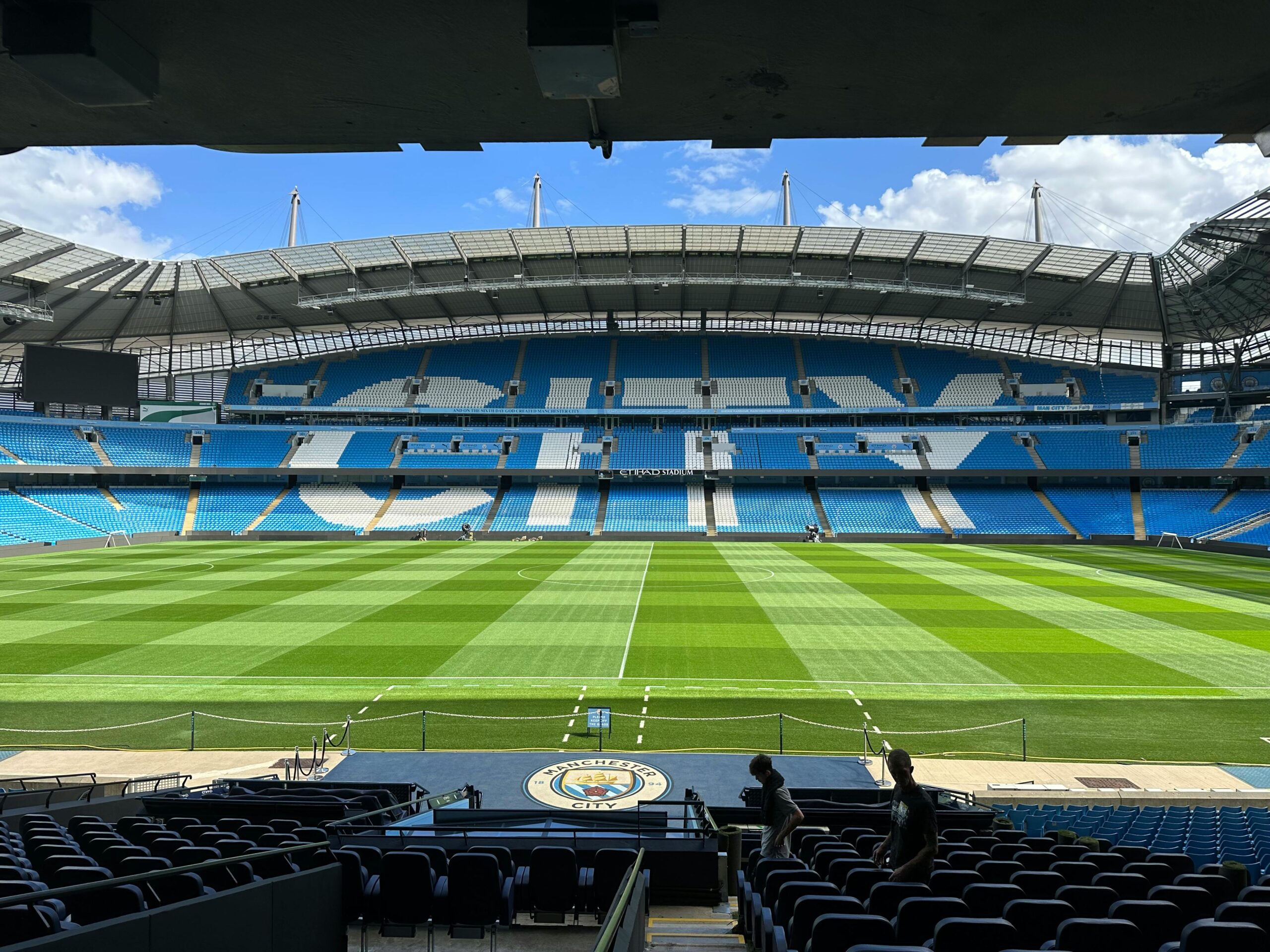
Are Manchester City guilty or innocent of the 114 Premier League financial regulation charges they face?
As sure as eggs is eggs, FSOM has no idea, him not being a barrister (although he does make a decent cup of coffee) nor a forensic accountant.
But whether City will be convicted and banished to football’s Land of Nod, this whole episode has highlighted one thing; how one-eyed football fans are when it comes to defending their club. and even that one eye is blinkered.
Even writing this, FSOM realises he could be subject to the sort of pile-on Sicilian families did with pillows to see off ailing ageing relatives.
Let’s be honest, some football clubs have pretty sketchy owners who under normal circumstances, you would not want within a country mile of your front door.
But if they take over your football club, it appears all bets are off. Football fans will forgive – or at least overlook – their owners worst shenanigans provided they start flashing the cash and writing cheques.
The majority of football fans don’t give a tinker’s cuss who runs their club and what they have been up to, all they want is transfer windows choc-full of multi-million pound signings, to sate their cravings like kids in a sweet shop.
And if somebody has the temerity to question the source of the wealth, well be ready to have the roof cave in on your head.
Even accepting there is a degree of jealousy among fans when they see rivals buying their way to the top, the degree to which supporters will forgive and back their club and its owners, goes beyond mere loyalty.
This probably began when Chelsea were bought by a Russian billionaire named Roman Abramovich. Almost single-handedly, he changed the face of the Premier League with the vast sums he was able and willing to pump into the club. Chelsea had been backed healthily and wealthily by Matthew Harding, an English millionaire who was killed in a helicopter crash.
But Abramovich was different gravy, with the huge sums he was prepared to splash out. It made for a very skewed playing field as Chelsea dominated the Premier League for a few years. That dominance attracted criticism, some of it fair from a genuine concern at the effect on the integrity of the Premier League, to outright jealousy.
And one of the questions asked was how Abramovich made his vast fortune. He seemed such a nice chap. He kept a low profile, didn’t shout the odds and was genuinely a fan, but in the post-collapse of the Soviet Union, a new word emerged – oligarch.
Abramovich was one, and like most Russian oligarchs, he made his fortune in the economic Wild West that was post-Soviet Russia.
He started with a small toy-making business, making rubber ducks and trading petrol and cigarettes, a bit like Private Walker from Dad’s Army but on a bigger scale, but his route to a gazillionaire is still cloaked in mystery.
Back then, having the right contacts and friends was the key to making your fortune and he had close links to Vladimir Putin, who emerged as Russia’s strong-arm leader, with US Intelligence dubbing Abramovich as ‘Putin’s bag man’.
In 1992 he did a stretch in jail for stealing government property and admitted he bribed government officials and worked with the sort of notorious Russian gangsters who would chop off bits of your anatomy and throw you into a frozen lake.
Those contacts worked as he acquired the Russian oil company Sibneft at a rigged auction for a heavily discounted price and later flogged it to Gazprom for £9.7billion.
It prompted the then Arsenal chairman David Dein to carp that Abramovich was ‘parking Russian tanks on the lawn and firing £50 notes at us’.
Not that it stopped Arsenal having their own Russian oligarch sipping the half-time tea and nibbling the sandwiches in the boardroom when Alisher Usmanov bought 30 per cent of the Gunners. He would have gobbled up the rest had American Stan Kroenke not outmaneuvered him.
But those same iffy and hooky contacts which served Abramovich well were his undoing as he – along with several other Russian oligarchs – was sanctioned by the UK government for his links to Putin following Russia’s 2022 invasion of Ukraine.
He was kicked out of the country, denied British citizenship and was forced to sell Chelsea, taking a £1.5bn bath in the process.
One of the biggest critics of Abramovich’s ownership of Chelsea was then-Liverpool chairman David Moores, whose family fortune was based in Littlewoods football pools (ask your grandad about them) and mail order fashions.
He bemoaned the lop-sided playing field that Abramovich brought to the Premier League but was close to selling a 30 per cent stake in the Reds to Thaksin Shinawatra, the then-prime minister of Thailand.
This delightful gentleman was described by Amnesty International as ‘a human rights abuser of the worst kind’ as he used a supposed war on drugs in Thailand to kill more than 2,000 people, over half of whom had no connection to the drugs trade but were political opponents.
In fairness, some Liverpool fans did display some conscience with the fanzine Through Wind and Rain saying: ‘We should have distanced ourselves from this guy from day one.’
Shinawatra was deposed in a military coup but in the space of 14 months bought and sold Manchester City.
To celebrate his takeover of City he hosted a Thailand-themed street party in Manchester’s Albert Square where City fans not only gave not a jot of thought to his background, but cheered him to the rafters, singing: ‘There’s only one Frank Sinatra’ finding Shinawatra as tricky to pronounce as easily as they ignored his dubious record.
After arrest warrants were issued in Thailand the Premier League advised it would be in the best interests for him to resign and sell up.
He did, and in rolled Sheikh Mansour from Abu Dhabi.
In contrast to the circus that surrounded Shinawatra, the Abu Dhabi purchase of City was measured and respectable.
Of course, in line with most Middle Eastern absolute monarchies, there were misgivings expressed by Amnesty International and others about the UAE’s record of severe human rights abuses, including arbitrary detention of dissidents and political opponents, unfair trials suppression of free expression and discrimination against vulnerable groups.
But as the Mansours bankrolled City to levels never even thought of, those clouds over their conduct and their ownership of City ever entered the heads of the vast majority of City fans who frankly didn’t care as billions were spent on recruiting some of the world’s best players to ensure City dominated the domestic game (apart from an Arsenal flavoured hiccup).
In their quest to dominate English football, City drove not just a coach and horses, but a herd of camels, through the game’s financial fair play rules.
Cue, those same City fans who turned a collective blind eye to the regime’s track record, leaping to the defence of their club which, to be fair, has played a bit of a blinder.
City’s owners have spent a fair wedge in investing in projects which have regenerated some pretty manky bits of Manchester and also invested elsewhere in the UK.
The old cynic in FSOM is bound to ask why they have done this; it’s certainly not that they have fallen in love with Manchester, but it’s given them access to a classic game of ‘I’ll take my ball home’ as they have threatened to pull the plug on all their UK investments and hinted at breaking off diplomatic relations if they are found guilty of charges and punished accordingly.
Yet throughout the history of City under the Mansour’s regime, from Abu Dhabi’s iffy rights record, to their off-the-scale cheating, City fans have stuck their heads in the sand; few, if any, have thought: ‘Do you know what? Perhaps our owners aren’t stand-up guys.’
The fans’ reaction to the charges and the accusations against the Mansours transcends mere the defence of their club and morphs into blind obedience and outrage that anybody could dare criticise their owners. Rather than do some navel-gazing on the conduct of City’s owners, most City supporters don’t give a tinker’s cuss and say it’s been worth it, even if City are relegated to the Lancashire Senior League.
When Newcastle were bought by the Saudi Arabians, few if any Geordies thought about the implications. Their reaction was to crow long and loud that they were about to become the richest club in the world, and they barely disguised their anticipation at seeing the world’s best players turning up on Tyneside.
They took it as an almost personal affront when it was pointed out that their club would be owned by a savage and vindictive regime which singled out journalist Jamal Khashoggi for special treatment when he set foot inside the Saudi consulate in Istanbul to tidy up some paperwork regarding his marriage.
Khashoggi, who was a dogged and persistent critic of the regime. was kidnapped, murdered, and with almost medieval barbarity, chopped into small enough pieces to cram into a holdall and pack off to Jeddah.
That didn’t bother Toon fans one jot and nor, it seems, does the fact that for the second year in a row Saudi Arabia has broken its record for executions.
In Saudi, thieves can still have their hands and feet lopped off and as for the treatment of the 19 million migrant workers in the desert kingdom, don’t even go there.
But none of this seems to bother Newcastle fans who far from raising a questioning eyebrow at their owners’ antics, amusingly stuck tea towels on their heads in an attempt to make the Saudis feel welcome.
Perhaps FSOM is being harsh on those one-eyed fans of clubs owned by dodgy regimes.
Author Raymond Chandler’s private eye Philip Marlowe said in The Long Goodbye: ‘The only difference between big business and organised crime is capital’ and at the risk of sounding like a paid-up member of Karl Marx’s fan club, even those clubs owned by seemingly benign and innocuous entities don’t wriggle off entirely scot-free. The baggage comes with private equity firms whose interest is purely financial, and energy drink manufacturers (no names!) whose addictive products can condemn kids to a sugary hyped-up life of running across the ceiling.
English football is an attractive proposition for potential investors and owners, and the Premier League’s global power and brand make it an ideal opportunity for a bit of sportswashing.
If your reputation is in the sink because your method of dealing with those who criticise you tends to run to lopping bits of them off or throwing them into a prison and dropping the key in the desert sand, what better way to clean it up than to buy a football club, and bankroll it to success so that people talk about that and forget what you have been up to?
Not everyone will forget and there will be those who occasionally stick their heads over the parapet and risk a brick on the noggin.
But you can always rely on your fans to slap a blinker on their blind eye and back you to the hilt.
Share this:
- Share on Bluesky (Opens in new window) Bluesky
- Email a link to a friend (Opens in new window) Email
- Share on Facebook (Opens in new window) Facebook
- Share on Reddit (Opens in new window) Reddit
- Share on Threads (Opens in new window) Threads
- Share on WhatsApp (Opens in new window) WhatsApp
- Share on X (Opens in new window) X
Related

Must See
-


European
/ 11 hours agoJesus Owono feels ‘enormous pain’ after Tenerife striker Jesus de Miguel’s death as Andorra goalkeeper opens up on ‘the most difficult days of my life’
Jesus Owono says he is going through ‘enormous pain’ and ‘the most difficult days...
-


50 Shades of May
/ 1 day agoFSOM: Man City’s Premier League charges saga shows how blinkered fans can be when defending their club – it morphs into blind obedience and outrage at any owner criticism
Are Manchester City guilty or innocent of the 114 Premier League financial regulation charges...
By John May -


European
/ 2 days agoTenerife striker Jesus de Miguel dies after on-field collision with Andorra goalkeeper Jesus Owono during Spanish second-division match
Tenerife striker Jesus de Miguel has died after an on-field collision during his team’s...


