
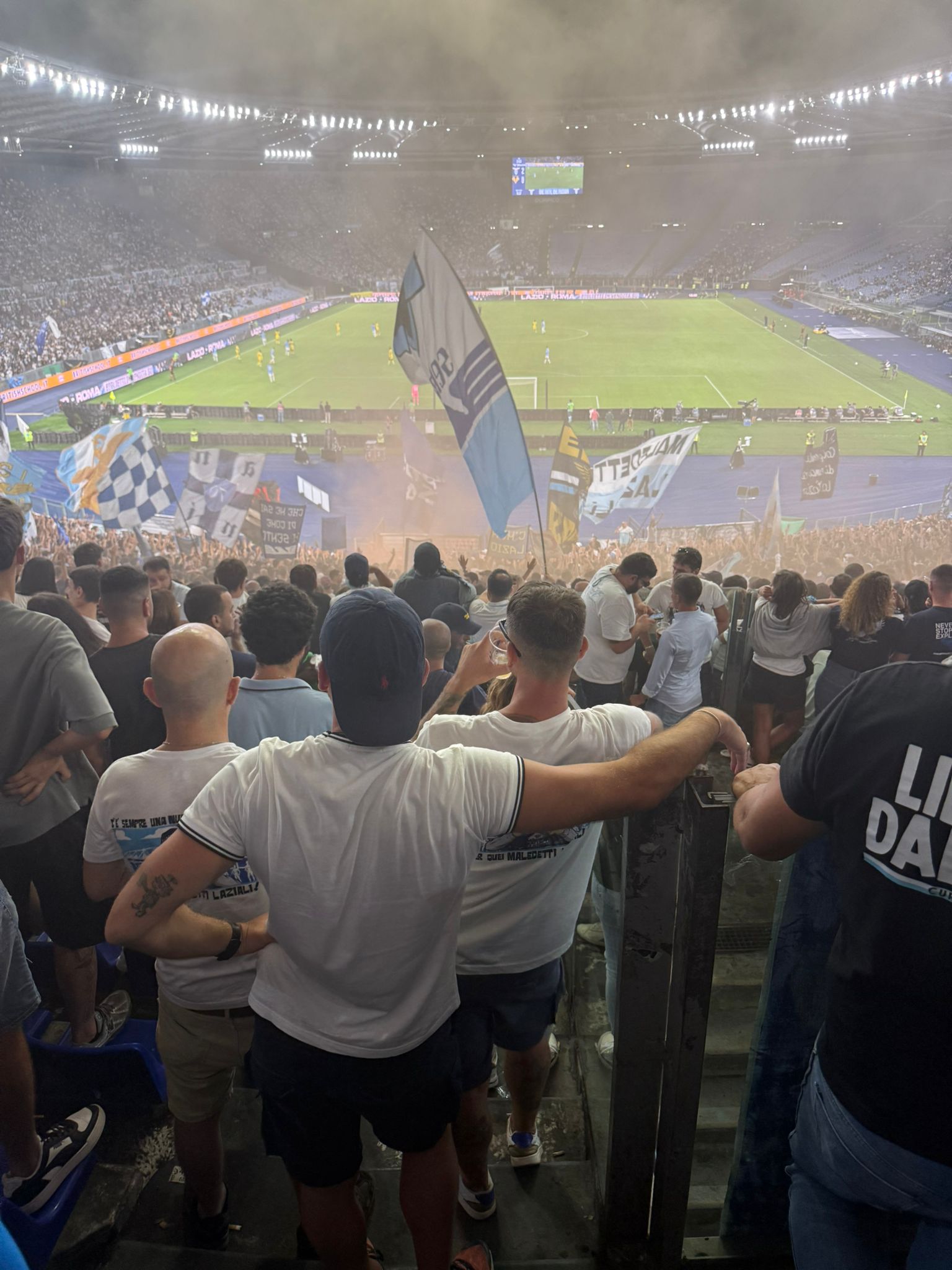
After the first week delivered a promising trip up to Como, the reality check came swiftly—and sharply. Despite the picturesque setting and the excitement of travel, the match itself was a painful dose of alarm.
The 2–0 defeat not only exposed Lazio’s weaknesses on the pitch but also left me anxious about the long, gruelling season ahead. That early stumble now lingers in my mind as I contemplate what lies next.
This week’s adventure was my first home game of the season with the 8.45pm kick-off against Hellas Verona.
I am pleased and relieved to say that we managed to bounce-back at the Stadio Olimpico and delivered a resounding response.
Lazio cruised to a 4–0 victory, truly reclaiming their pride on home soil.
Goals came early and often—Matteo Guendouzi opened the scoring in the 3rd minute, Mattia Zaccagni followed in the 10th against his old team. Valentín (Taty) Castellanos added another just before halftime in the 41st minute. The rout was sealed when Boulaye Dia struck late, in the 82nd minute.
But as always this is only part of my story!
The journey down
Fortunately, this year marks my third season back as a Lazio season ticket holder. Over the summer I seriously considered moving from the Curva Nord to the more comfortable Tevere. But deep down I knew I’d regret it.
The Curva isn’t just where you watch football—it’s where you live it. The atmosphere, the chants, the chaos—I couldn’t give that up.
I set my alarm for 8am, ready for my 10am train to Rome. After driving to the local tram stop and leaving my car there for the weekend, the first mission of the day was simple: coffee and a pastry to get myself moving. With that sorted, it was time to hit the tracks.
Say what you want about Italy’s trains, but I love them. If you book in advance, you can usually get a really good deal.
The regional ones are cheap and cheerful, though painfully slow, so for trips to Rome I always go with the fast trains.
The choice is between the national Frecciarossa or the private company Italo. It reminds me a bit of tea in Ireland—your household is either Barry’s or Lyons. I’m firmly Team Barry’s, and when it comes to trains, I’m firmly Team Italo.
My only gripe is that stations seem to have it in for them! They only announce the platform 5–10 minutes before departure, so it’s always a mad dash to board.
For this trip, I got a bargain—€22.90 on the way down and €27.90 back. Compared to the cost of driving from Florence to Rome, which would easily set me back around €120 with tolls, it felt like daylight robbery in my favour.
After a smooth 90-minute journey, I jumped straight onto the metro at Termini. I headed to Ottaviano, and then hopped on the 32 bus that took me to my hotel.
Food issues and checking into the hotel
The plan had been simple: grab a light lunch, nothing heavy, just enough to tide me over. But once I got to Rome, the craving for a proper plate of pasta hit, and my mind was set on an amatriciana.
After hopping off the bus on my way to the Grand Hotel Fleming, I detoured to Florito—a little spot I’ve been to a few times and always enjoyed. To my disappointment, the shutters were down. Google Maps claimed it was open, but reality had other ideas.
I wandered around Flaminia (not to be confused with Flaminio), trying my luck at a couple of other places.
The problem was obvious: August in Rome, especially in residential areas away from the tourist traps, means closed kitchens and locked doors. Lunch was proving harder to find than expected.
I decided to cut my losses and head to the hotel, half-expecting to be turned away for arriving early.
To my relief, my room at the Grand Hotel Fleming was ready. I’ve lost count of how many times I’ve stayed there—fifteen at least—and it never lets me down.
It’s perfect for matchdays: a short walk to the Olimpico, and no hassle with traffic or public transport after the final whistle. Bags dropped, I set back out in search of food.
This time I made for Ponte Milvio, knowing I’d have better luck there. My first stop was Sugo, but even though it was gone 1pm and there were plenty of empty tables, they were fully booked.
No arguments – I accepted defeat and moved on. Roma Beer Company came to the rescue. A couple of medium beers (which were practically pints) washed down a hearty plate of pasta, followed by a cracking Caesar salad.
My wife has banned me from Super T as I have previously mentioned, but she never mentioned anything about strong beer.
So when I saw Monastier Double IPA at 8.5% on the menu, I couldn’t resist. It was delicious, dangerously strong, and after two glasses I knew that was enough—at least for lunch.
With food finally sorted and a buzz from the beer, I headed back to the hotel for a bit of downtime before the evening, when it was time to return to Ponte Milvio to meet up with friends.
Pre-match pints and friends
One of the truly special things about football is the way it brings people together. It’s not just about the ninety minutes on the pitch—it’s the friendships, the reunions, and the chance encounters that make the whole experience richer.
About fifteen years ago, I was fortunate enough to join Lazioland, an international fan group run by a couple of Italians for Lazio supporters across the world.
It’s been a brilliant community. Before the big Rome derbies, we always get together the night before for a meal or drinks, and sometimes we organise meet-ups for other matches too.
At Ponte Milvio, I linked up with Andi, an Austrian friend from Lazioland, who had brought along his nine-year-old son for his very first Lazio game. What a match to start a lifelong journey with the club!
We were also joined by Silvia, an old friend from Latina who I first met years ago at one of those gatherings. Usually we bump into each other by chance outside the stadium. But this time we made a point of swapping numbers to make sure we meet more regularly.
Then there was Lucio, an Italian living in Turkey and working at a clinic specialising in hair transplants. As someone who lost most of mine years ago, I couldn’t resist asking him about the cost.
He gave me a quick inspection, told me I’d probably need two sessions, and even offered a ballpark figure.
To be fair, I’ve made my peace with shaving what little remains—but I had to admire his professionalism. Maybe if I’d been younger, I might have been tempted!
Eventually, the others went off to grab some food before the match, but I was still too full from my Ponte Milvio lunch. Instead, I made my way towards the gathering point, ready to join the Ultras walk to the Olimpico.
The walk to the stadium
Earlier in the week it had been announced that the Ultras would lead a march from Ponte Milvio to the Olimpico at 7.30pm.
By the time I arrived, the crowd had already formed and was on the move. I slipped in towards the back, quickly swept up in the noise and energy.
Just like inside the stadium, the Ultras set the pace with chants and songs—many of them aimed at Claudio Lotito.
Once, Lazio’s president was seen as the man who saved the club from bankruptcy, stabilising finances when things looked desperate.
But time has soured that legacy. Over the years, frustration has grown, and this summer’s blunders, which led to a transfer ban, only deepened the divide. For many fans, the patience is gone.
Unlike Aurelio De Laurentiis at Napoli, Lotito hasn’t really built anything lasting to match his initial rescue act.
Still, the atmosphere along the walk was electric. Despite the disappointment of the opening game and the cloud of the transfer ban, the fans were in full voice.
That’s something I’ve always admired about this fanbase: win, lose, or draw, they never stop singing.
Even last season, when Lazio were hammered 6–0 at home by Inter, the Curva Nord sang until the end—so much so that Marcus Thuram himself pointed to the stand in appreciation of the loyalty he’d just witnessed.
By the time we reached the Olimpico, I grabbed a quick Caffè Borghetti from a vendor—an essential Roman ritual. It’s a sweet coffee liqueur that gives you a little kick before the match.
Outside the stadium it goes for €2 a shot, but near Ponte Milvio you’ll often see the deal: three for a fiver. Perfect fuel for the final push through the gates.
Normally, I like to head in early to avoid the crush at the turnstiles, but the march meant I arrived later than usual. Maybe that explained the lighter-than-normal security.
To my surprise, the bag checks were quick, almost casual. They took away the bottle of water I’d forgotten to ditch—typical, like in England—but somehow the lads with flares and weed had no problem getting theirs through. Only in Italy!
The match
Once inside the Olimpico, I grabbed a couple of beers and made my way into the Curva, settling in near the group of Tuscan Lazio fans.
The atmosphere was already buzzing, but the real spine-tingling moment came as the team line-ups were read out.
Hearing Maurizio Sarri’s name greeted with such warmth, and then sung again during the game, was genuinely moving.
I’ve missed him dearly since his resignation back in March 2024, and it felt right to hear the Curva pay tribute.
On the pitch, Lazio produced the perfect response to the disappointment of week one. A commanding 4–0 victory over Hellas Verona.
Matteo Guendouzi set the tone just three minutes in, calmly finishing after clever link-up play with Taty Castellanos. Mattia Zaccagni doubled the lead in the 10th minute following a sensational rabona assist from Castellanos. The Argentine striker got on the scoresheet himself, heading in from a Nicolò Rovella free-kick just before half-time.
Substitute Boulaye Dia wrapped things up late on after fine work down the left from Luca Pellegrini and Reda Belahyane.
The Olimpico crowd revelled in the attacking display but it was Taty Castellanos who stole the show. He was involved in three of the four goals and rightly named man of the match.
Half-time brought a bit of drama off the pitch as well. A group of fans returned to their places empty-handed, frustrated that the kiosks had apparently run out of beer.
Fortunately, by the time I made my own inevitable trip downstairs—having already had more than enough to drink—the situation had been resolved.
After battling through the usual crowd blocking the stairways, I did what any sensible fan would: relieved myself, then picked up another two beers on the way back up.
The singing never let up. From the first whistle to the last, the Curva was relentless.
The anti-Lotito chants in particular grew louder with each goal, blending anger and celebration in that uniquely Roman way.
Whatever the result on the pitch, the Curva always delivers—and tonight was no exception.
Post-match celebrations
After the final whistle, I grabbed a porchetta panini outside the Olimpico. It was generous, juicy, and well worth the €7. After I made my way back to Ponte Milvio to meet up with some Italian friends.
Funny enough, these were people I’d only met back in May after Lazio–Lecce, on a night when I was a little worse for wear and half-convinced I’d embarrassed myself.
As it turned out, they were genuinely happy to see me again, and it felt like reconnecting with old mates.
This time we managed to get into Sugo, the very restaurant that had turned me away at lunchtime, though my new friends had no trouble securing us a table.
For the second time that day I ordered amatriciana—and once again, it was spot on. After dinner, the evening drifted into exactly what you’d hope for after a big Lazio win: more drinks, plenty of football chat, and the chance to meet even more new people.
By the time I finally said my goodbyes it was 2:30am, and to be honest, I wasn’t exactly in the best shape. With an early morning train looming, I knew the return journey to Florence would be grim.
I was right – I couldn’t even face the metro or bus and ended up splashing out on a taxi to Termini. The train ride back was shaky, to say the least! Once home I crashed out for a few hours, hoping to feel vaguely normal again.
The matchday experience
- Stadium Name: Stadio Olimpico (Rome)
- Attendance: 40,000
- Ticket Price: €35 for the Curva Nord but season ticket 280
- Train Costs: €50.80 round trip (Italo, Florence–Rome, €22.90 down + €27.90 back)
- Parking: €0 … cheeky bonus (local tram stop for the weekend)
- Hotel: Grand Hotel Fleming €76.50 plus €7.50 city tax
- Beer-o-Meter: A lot! The highlight was the two Monastier Double IPAs (8.5%) at €7. The stadium beers were Peroni on tap at €5 which were fine but nothing special.
- Food: Porchetta panini €7; Ponte Milvio lunch €30; Dinner at Sugo €20
- Taxi: €17
- Waiting time to leave the stadium: N\A for the home game
This trip was more social than I expected. I spent a lot more than I wanted but it was really fun!
In summary
Football with Lazio is never just ninety minutes—it is belonging, devotion, and memory woven together in sky blue.
From the chaos of Ponte Milvio to the thunder of the Curva Nord, every journey pulls me deeper into this bond. The 4–0 against Verona wasn’t simply a victory but it was pride reborn. A reminder that even after stumbles and frustrations, this team has the power to lift hearts and carry us forward.
And yet, as much as I bask in the glory of goals and chants, reality always sneaks in. The mad dash to catch trains, the endless hunt for a proper plate of pasta, the dangerously strong beers, and a taxi ride I probably couldn’t afford.
Supporting Lazio might shave years off my life! But it also gives me some of the richest, most absurd, and most joyful memories imaginable.
Because no matter the chaos, the triumphs, or the hangovers, one thing remains certain: I’ll keep coming back, season after season, for the team, the fans, and the feeling that only Lazio can give.
Share this:
- Share on Bluesky (Opens in new window) Bluesky
- Email a link to a friend (Opens in new window) Email
- Share on Facebook (Opens in new window) Facebook
- Share on Reddit (Opens in new window) Reddit
- Share on Threads (Opens in new window) Threads
- Share on WhatsApp (Opens in new window) WhatsApp
- Share on X (Opens in new window) X
Related

Must See
-


Football
/ 2 weeks agoLionel Messi RETIRES from Argentina duty – as icon reveals he has ‘nothing left to give’
Lionel Messi has announced his retirement from Argentina duty, citing that he has ‘nothing...
-


Fantasy Football
/ 1 month agoFantasy Football Premier League: Can you top TIBS News’ table for the 2026-27 season?
The 2026-27 Premier League season is nearly upon us and that can only mean...
-


Features
/ 9 months agoEXCLUSIVE INTERVIEW: Marc White on Dorking Wanderers’ rise from park football to global screens and their future aspirations
Dorking Wanderers, a National League South side with international recognition, are taking the social...
By Jameel Mulla


2 Comments